







Top 7 IFS Field Service Alternatives for Equipment-Centric Teams (2026)

IFS combines field service management with ERP and enterprise asset management on one platform. That scope suits complex organizations standardizing on IFS.
This guide compares Service Pro by MSI Data, ServiceMax, Salesforce Field Service, Microsoft Dynamics 365 Field Service, ServiceNow, SAP Field Service Management, and ServiceTitan.
Why Do Equipment Teams Look for IFS Alternatives
Consider a 50-to-200-technician equipment service operation that wants faster dispatch and invoicing while keeping its existing ERP. A narrower field service platform is built for that scope.
IFS's own upgrade guidance puts a full transformation at 12 to 18 months, depending on the organization's starting point and integration requirements. In the IFS Community, one user described an original implementation that ran past 18 months. Another reported an Apps-to-Cloud upgrade still underway after about 12 months. Ask for a phased plan with defined operational milestones before committing.
At that size, implementation timing decides whether the platform improves field execution inside the current planning cycle or turns into a broader transformation program.
Other friction points surface regularly when equipment teams start looking elsewhere:
- ERP integration complexity. IFS is built as an integrated ERP, EAM, and field service platform. For teams on Sage 100, NetSuite, Epicor Prophet 21, or Microsoft Dynamics Business Central, scope what has to be built and maintained to keep the ERP as the system of record without re-keying field data.
- Technician adoption. In IFS Community discussions, some existing users describe the move from Enterprise Explorer to Aurena as challenging, citing extra steps in familiar workflows. Test real technician and billing workflows before selecting a platform.
- Cost structure mismatch. Total cost runs well past subscription pricing, from implementation services to ongoing interface maintenance. IFS's own upgrade guidance notes that customizations and technical debt shape upgrade effort.
Where Does IFS Field Service Fit Best
IFS Field Service Management fits large enterprises running multi-region service operations in utilities or telecom. At that scale, a long implementation and a dedicated IT team for upgrades are part of the plan.
If you run 500-plus technicians across multiple countries and already have IFS ERP or EAM in place, IFS unifies service and maintenance on the platform you already own.
How Should You Evaluate Field Service Alternatives
Most field service platforms call themselves "comprehensive," but that label doesn't tell you whether the software fits the way equipment-centric service teams actually work. A platform built for high-volume residential HVAC repair breaks down when you try to run multi-visit commissioning jobs with contract billing and compliance documentation. A CRM-first platform requires heavy configuration to enforce warranty coverage at the work-order level.
The criteria below are specific to equipment service operations managing cranes, power generation systems, industrial refrigeration, and other large physical assets where the job isn't finished until the asset record, contract status, invoice, and compliance documentation are all updated in sync.
Does It Fit Asset-Centric Service
Asset-centric field service management means the software tracks individual pieces of equipment, their full service history, warranty status, contract coverage, and maintenance schedules at the work-order level, not just at the customer account level. A technician opening a job for a specific crane or generator should see that asset's maintenance records, open work orders, and whether the repair falls under warranty or a service contract before they leave the shop.
Platforms built from the CRM outward often store asset data as a secondary object under the account, which means technicians and dispatchers drill through multiple screens to find the information they need to price and execute the job correctly.
Can Technicians Work Offline
Technicians working in basements, substations, manufacturing floors, and remote power generation sites lose cell coverage regularly. If the mobile app requires a live connection to complete a work order, capture parts used, or log time, the technician either waits until they get back to the truck or writes it down on paper and re-enters it later.
Real offline capability means the technician can open the job, update status, attach photos, record parts, and close the work order while disconnected, with the platform syncing everything back when connectivity returns. Platforms that claim offline support but only cache read-only job details don't solve the problem.
Can It Enforce Contracts and Warranties at the Work Order
If contract and warranty data sits in a separate module, it won't surface as a dispatcher creates the work order or a technician opens the job. The technician bills the customer for labor and parts, and the invoice goes out. Weeks later, the back office finds the repair was covered under warranty. For equipment teams managing hundreds of assets under overlapping service contracts and manufacturer warranties, coverage has to be checked when the work order is created.
Will It Connect to Your ERP Without a Rip-and-Replace
The most common fear among mid-market service teams evaluating FSM platforms is being told they need to replace Sage, NetSuite, Epicor, or Business Central to make the new system work. The integration question isn't whether the FSM vendor has an API. It's whether the platform connects natively to the ERP already in place, syncs work orders, invoices, parts, and customer data in both directions without manual re-keying, and does that without a separate integration project that adds six months to the timeline.
Platforms that describe their ERP integration as "flexible" or "API-enabled" often mean the customer is responsible for building and maintaining the connection, which is a cost and governance problem for teams without a full-time integration engineer on staff.
Can Your Team Adopt It Before the Next Renewal Cycle
One buyer said it plainly: "I won't implement anything new midyear." Adoption timing is a hard constraint. The platform has to reach technicians before the next contract renewal or busy season. A long implementation or extensive custom development pushes go-live past the point where the business case still holds. Ask each vendor for a rollout plan scoped to your core workflows, starting with scheduling and billing.
Which Metrics Prove the Switch
Benchmark these four numbers before switching and track them after:
- First-time fix rate: The share of jobs completed on the first visit.
- Time-to-invoice: The time from job completion to a clean invoice going out. The goal is to remove the handoffs that keep completed work stuck in work-in-progress, such as missing notes and manual re-entry.
- Warranty revenue recovered: Valid warranty work identified and claimed before it becomes a write-off.
- Technician utilization: The share of paid technician hours spent on billable work. Dispatch that accounts for skills and location cuts travel and idle time.
What Are the Top 7 IFS Field Service Alternatives
The seven platforms below cover different organizational profiles, and no single alternative fits every equipment team.
Service Pro by MSI Data
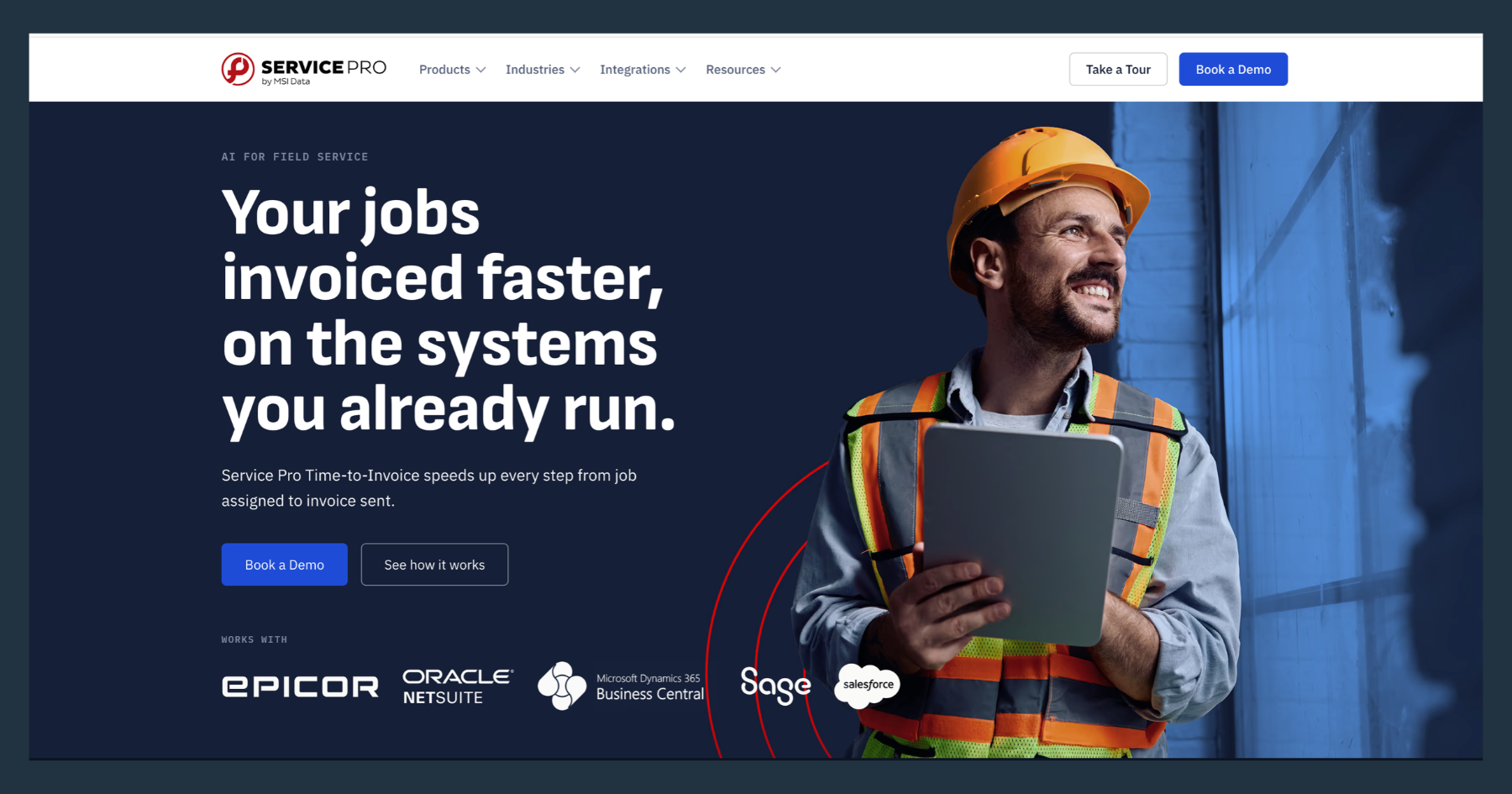
Service Pro FSM is an asset-centric field service management platform built exclusively for equipment-heavy service organizations in power generation, industrial equipment and manufacturing, and heavy equipment.
- Asset and work order management. Technicians see the equipment's full service history on the job.
- Offline mobile access. Work continues without a signal and syncs when connectivity returns.
- Coverage enforcement at the work order. Contract and warranty coverage gets checked before the invoice goes out.
- Preventive maintenance. PM scheduling and compliance documentation run in the same system.
- Scheduling and dispatch. Dispatchers see technician status in real time.
- Native ERP integration. Direct connectors to Sage 100, NetSuite,, Epicor Prophet 21, and Microsoft Dynamics Business Central, plus a secure API.
Service Pro Time-to-Invoice adds purpose-built agents for field execution, revenue, and operations intelligence. Job prep briefs and real-time guidance support technicians. Invoice and warranty agents handle the revenue side. Daily profitability visibility replaces the batch report. Every trial includes a forward-deployed engineer embedded with the customer's team.
Service Pro FSM fits equipment-centric operations with $25M+ in annual revenue and 20+ field technicians. It isn't built for teams that need a lightweight scheduling tool or run CRM-first workflows.
ServiceMax
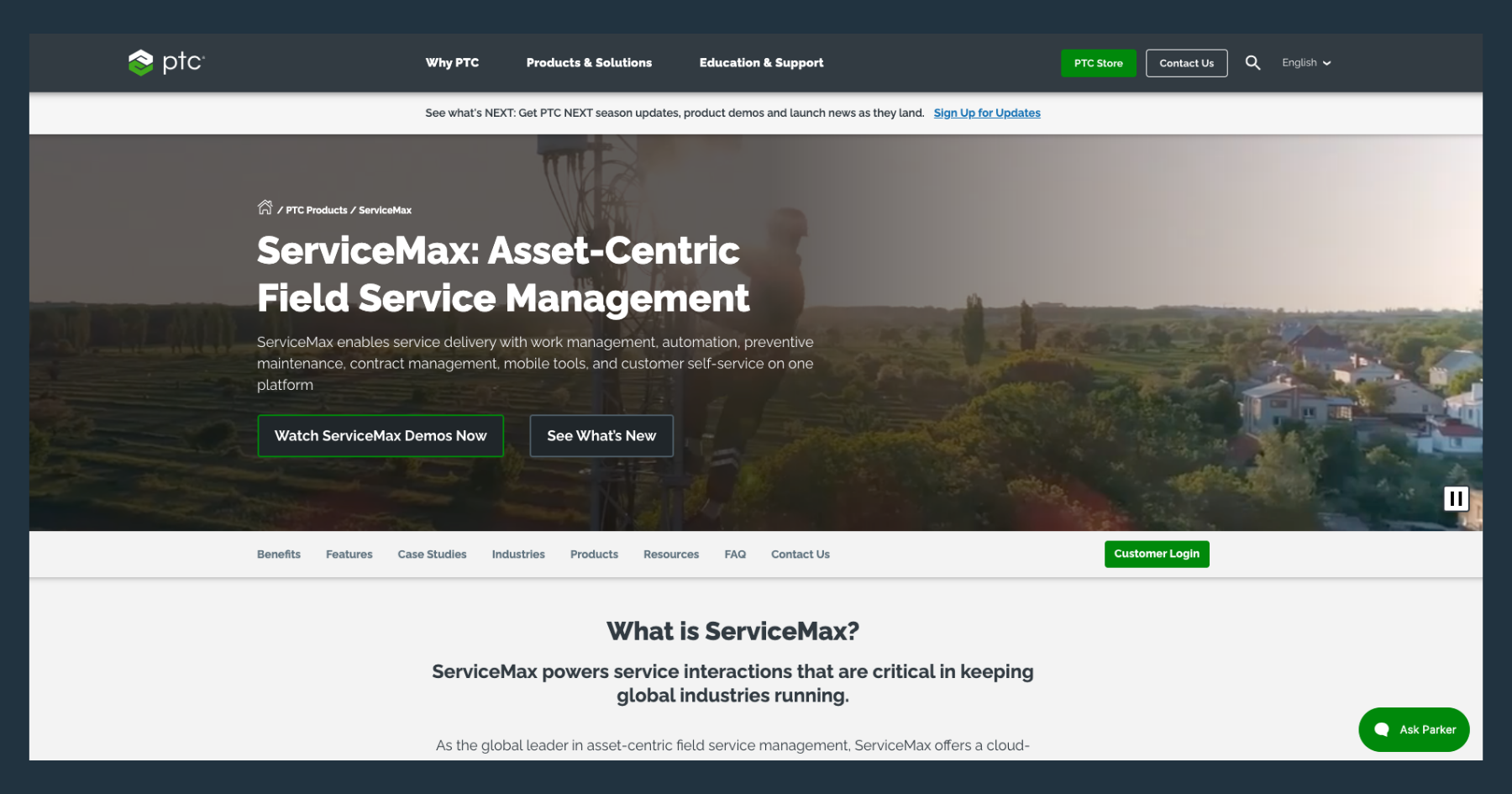
ServiceMax is built for asset-heavy service organizations managing installed-base records and warranty entitlements. It fits OEMs and service providers where asset history matters as much as dispatch.
As part of PTC, ServiceMax can connect to PTC's ThingWorx IoT platform. PTC says it uses real-time equipment data and service history to support diagnosis. Before selecting it, scope the Salesforce-based architecture and the internal resources needed to administer the platform.
Salesforce Field Service
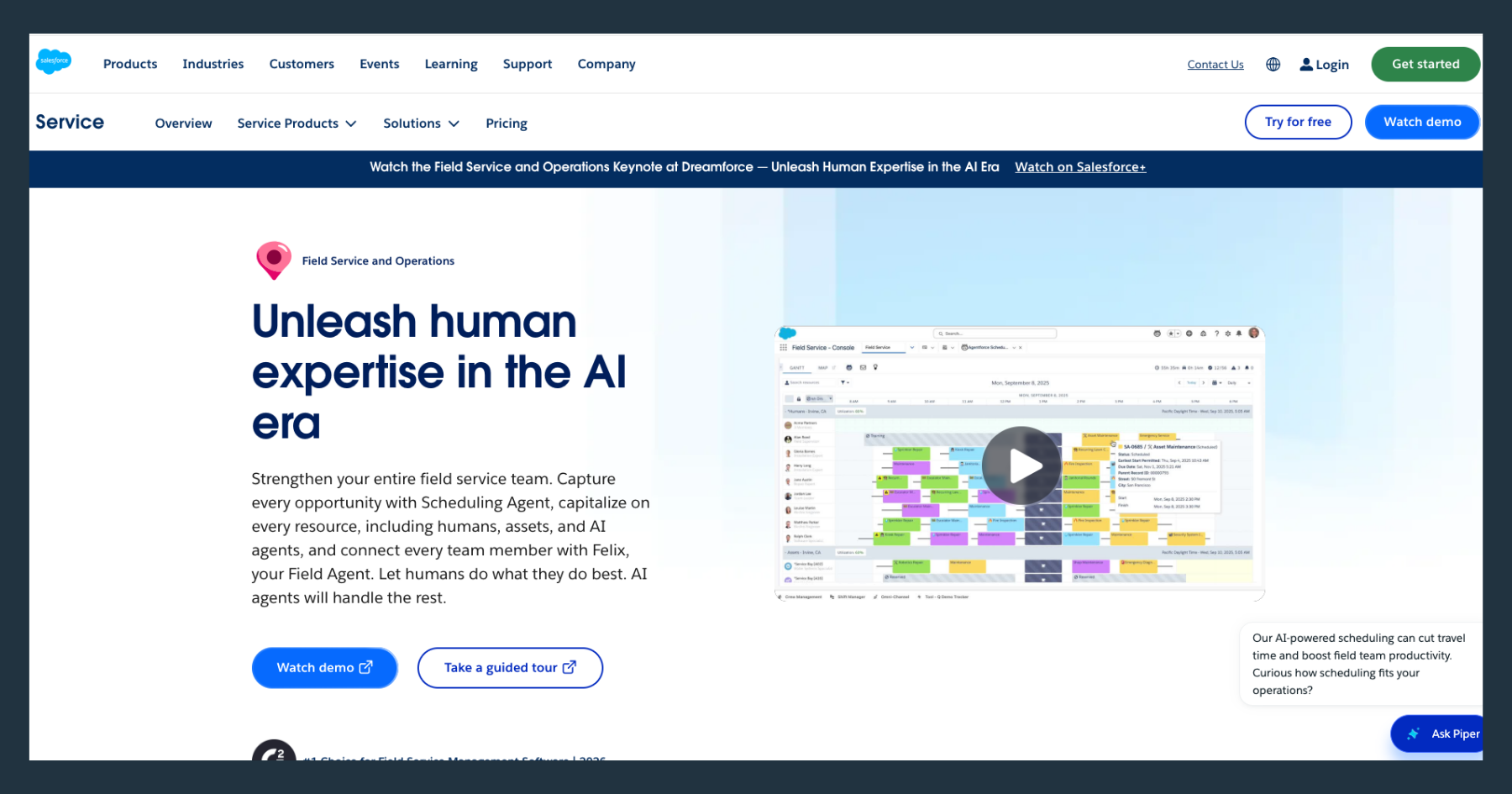
Salesforce Field Service fits operations where CRM data organizes service. It runs scheduling and dispatch on the Salesforce platform. Sales and service data stay connected from opportunity through renewal. Agentforce adds AI-assisted scheduling, with availability tied to edition and add-on licensing. Salesforce Field Service supports asset and warranty records. Assigning a standard product warranty to a new asset automatically takes a Flow, Process Builder, or trigger. Warranty automation isn't configured by default.
For asset-heavy organizations, test whether standard configuration covers the installed-base and entitlement depth you need. If it doesn't, extensions like ServiceMax Asset 360 add that layer.
Microsoft Dynamics 365 Field Service
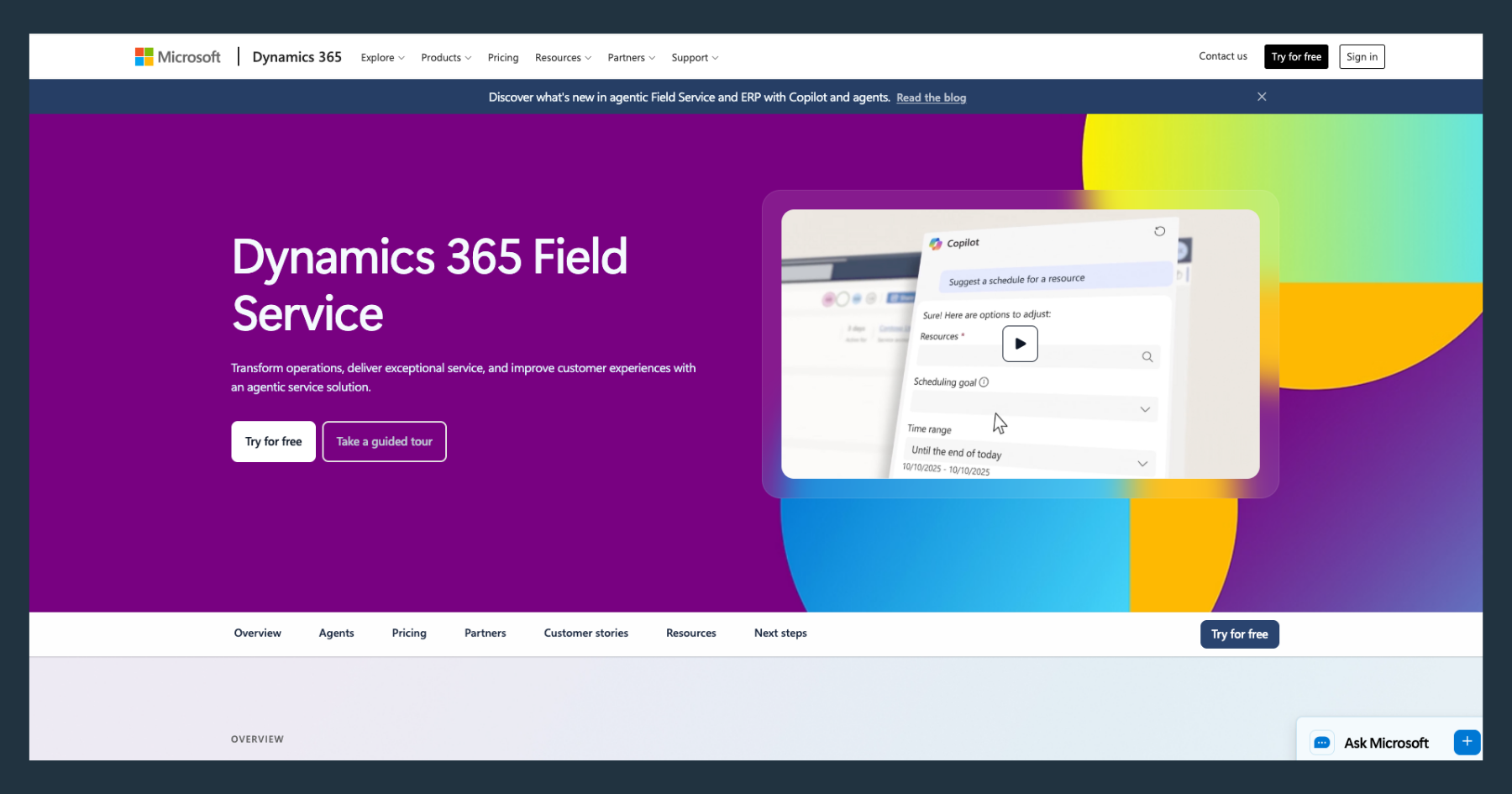
Microsoft Dynamics 365 Field Service fits organizations already standardized on Microsoft, including Dynamics 365 and the Power Platform. It covers work orders and scheduling, with asset tracking and agreement-based preventive maintenance built in.
Its advantage is strongest when the back office already runs Dynamics. Microsoft documents two-way integration with Dynamics 365 Supply Chain Management and Dataverse for inventory and asset data. Supported workflows sync work orders and invoicing data between the two.
For teams on Sage, NetSuite, Epicor, or another ERP, scope what data has to move between systems and who owns and maintains the interface.
ServiceNow Field Service Management
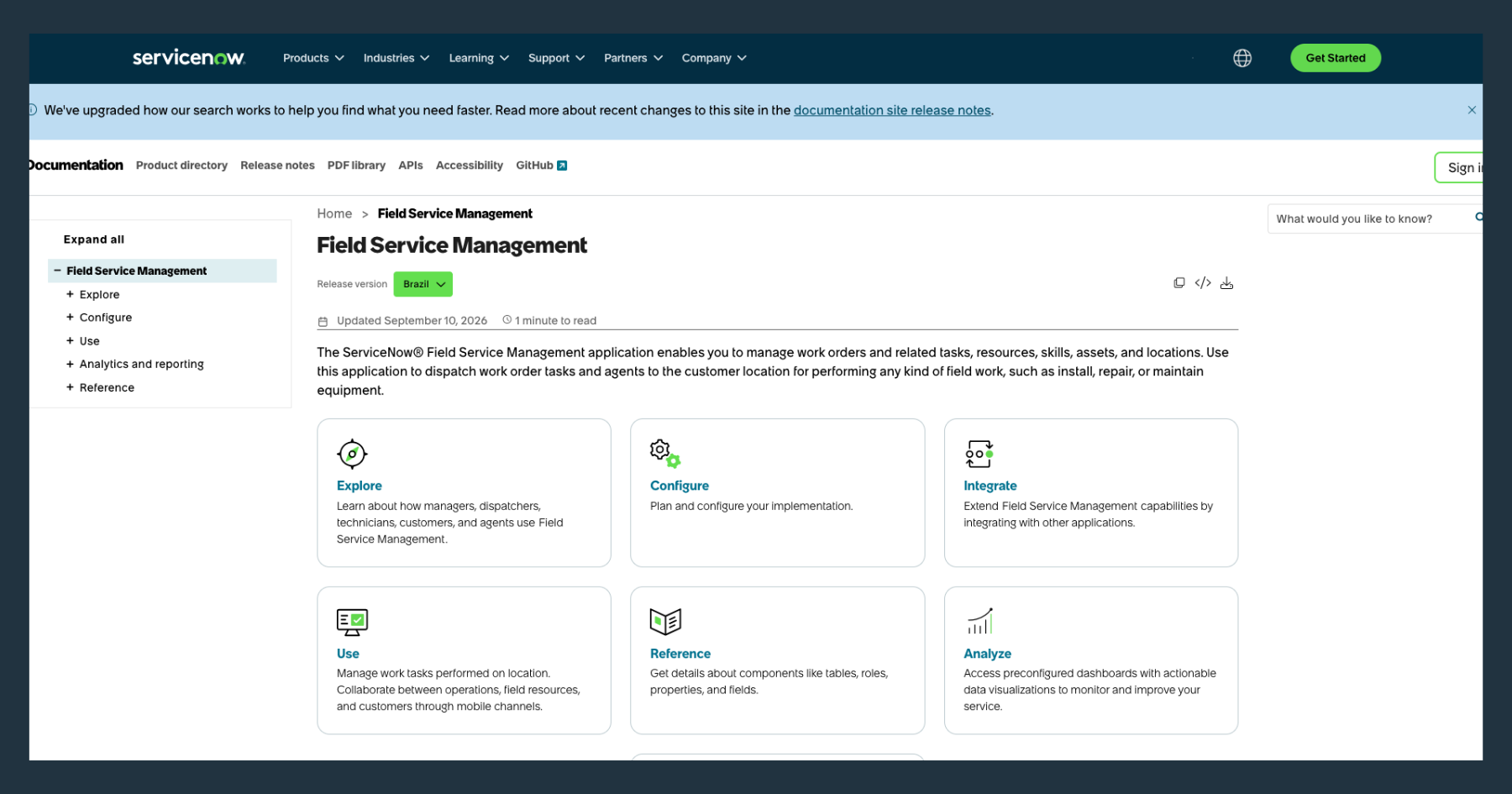
ServiceNow Field Service Management fits organizations that want field work connected to broader ServiceNow workflows. It covers work-order dispatch and billable-work reporting.
Work orders can be created directly from ServiceNow records such as cases and incidents. Service work stays connected to IT and customer-service workflows on the same platform.
For equipment-service teams, test its asset and warranty workflows against real service scenarios. The case is strongest when ServiceNow already runs across your operations. As a standalone field service purchase, it takes more evaluation.
SAP Field Service Management
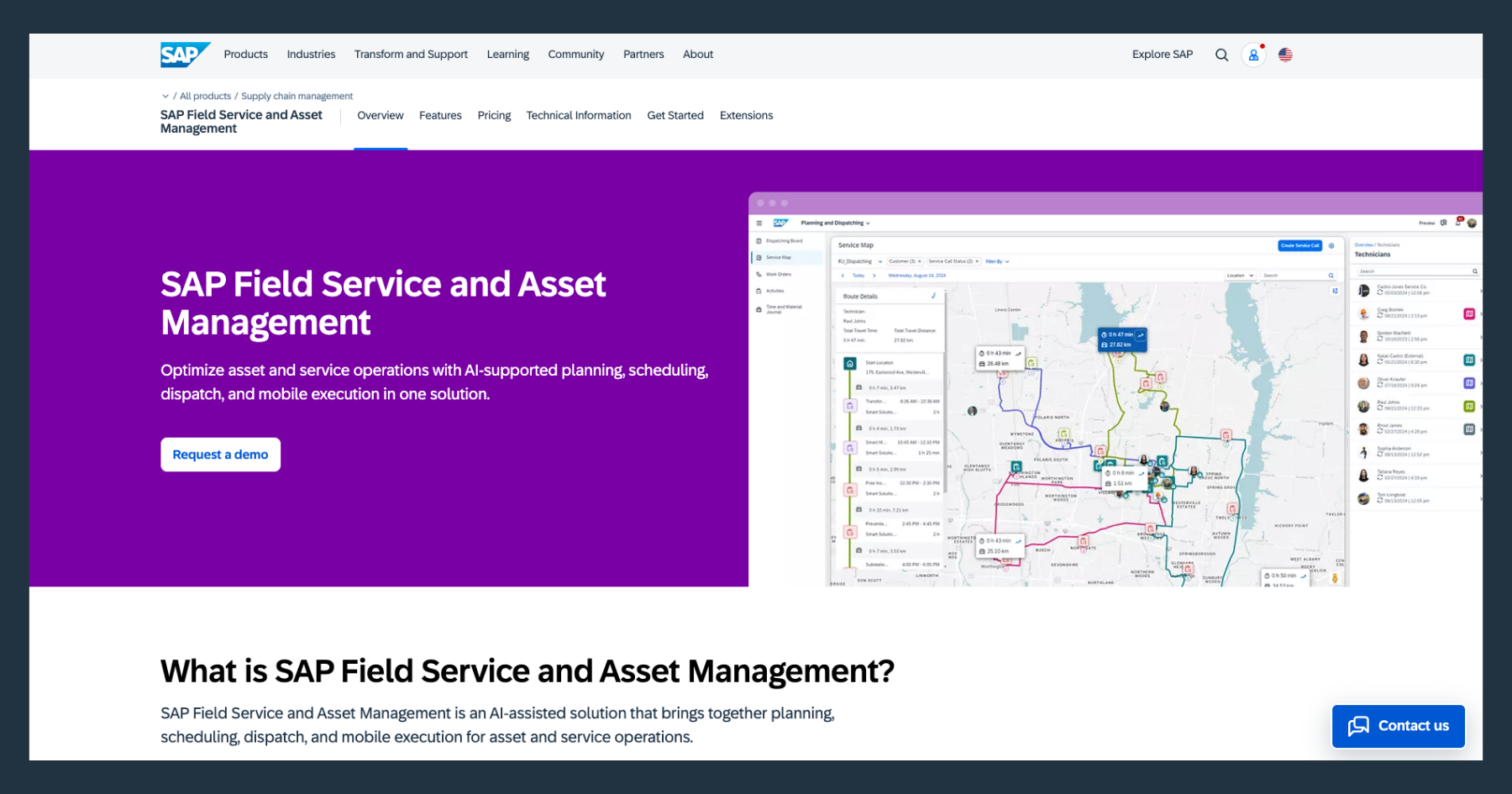
SAP Field Service Management fits organizations that want field execution tied closely to SAP S/4HANA service processes. It covers dispatch and mobile technician workflows, with machine learning and IoT supporting proactive service.
SAP documents integration with S/4HANA Cloud Public Edition and S/4HANA or S/4HANA Cloud Private Edition, configured through SAP Cloud Platform and SAP Cloud Integration. Service orders and equipment records map between the two systems.
Outside an SAP environment, SAP's integration overview lists support for selected external ERPs and connector options. For equipment-heavy teams, test preventive maintenance and warranty workflows during the demo and implementation scoping.
ServiceTitan
ServiceTitan is built for residential and commercial trades, including HVAC and plumbing. Its mobile app covers dispatch and in-field payments. It suits service businesses where technicians complete the work and collect payment in the same visit.
ServiceTitan now supports longer commercial-construction workflows, including progress billing and change orders.
For power generation and industrial equipment teams, test whether its trade-contractor workflow handles serialized assets and warranty entitlements. Run real work orders and asset histories through the evaluation, beyond a short-cycle repair demo.
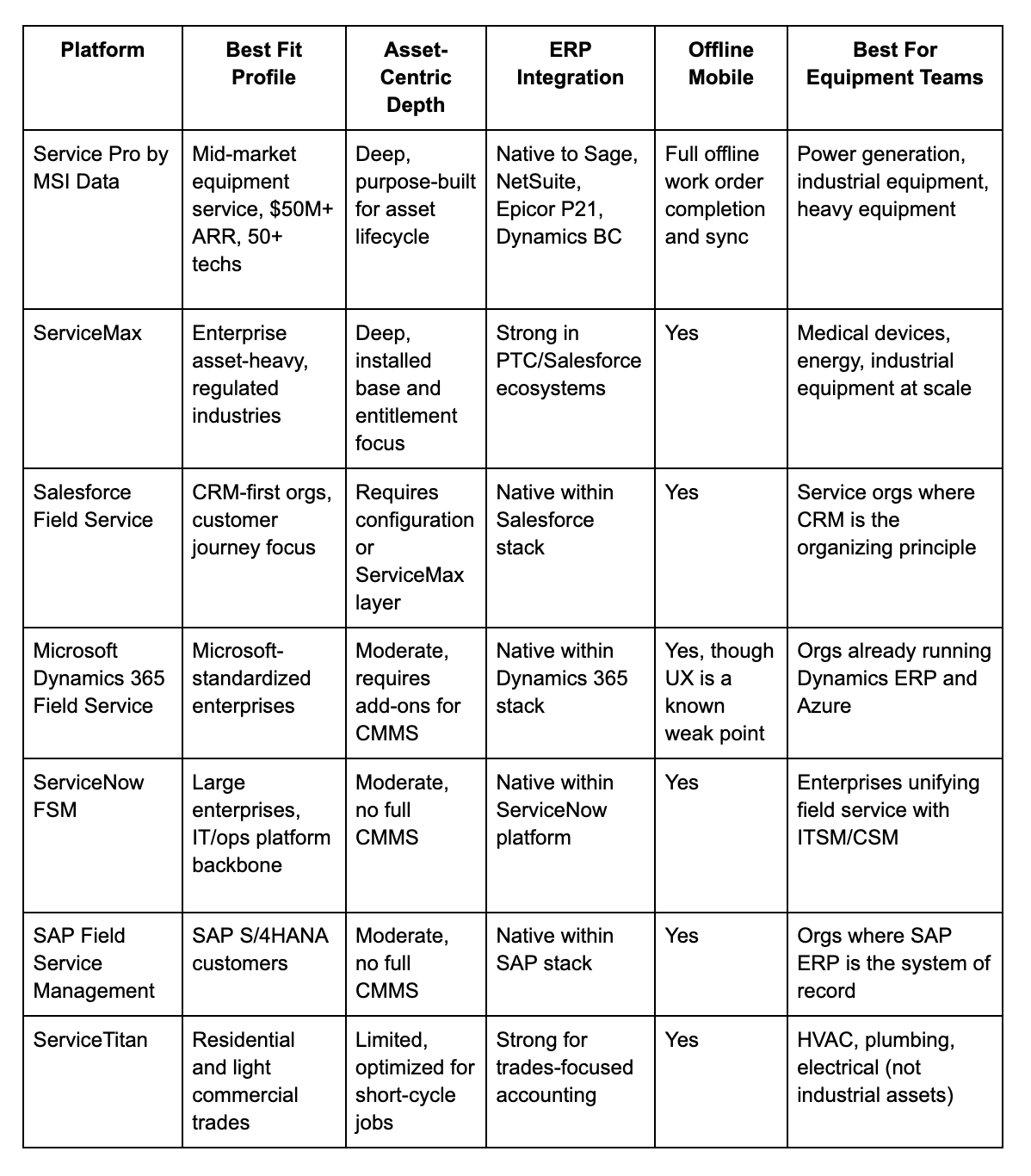
How Do IFS Alternatives Compare by Fit
When Should You Stay With IFS
Large, multi-region organizations with complex assets and an established IFS ERP or EAM backbone have the least to gain from switching. IFS is designed for asset-intensive enterprise operations in industries like utilities and telecommunications, where field service and back-office processes need to stay connected.
If your organization already has the IT resources and process maturity to support IFS Cloud, its breadth outweighs the cost and disruption of replacing it. IFS documents deployments serving more than 500 field technicians across power and communications infrastructure. If the frustration is with licensing or an aging IFS Applications environment, renegotiating or planning an IFS Cloud upgrade is the smaller fix.
Frequently Asked Questions
Who Are the Main Competitors of IFS Field Service Management
The primary competitors fall into two groups: enterprise-scale platforms including ServiceMax, Salesforce Field Service, Microsoft Dynamics 365, ServiceNow, and SAP FSM, and equipment-centric mid-market platforms like Service Pro by MSI Data.
What Field Service Software Is Best for Equipment-Centric Operations
Platforms built from the asset outward, with native contract and warranty enforcement at the work order level, are the strongest fit for equipment-centric operations. Service Pro by MSI Data is purpose-built for this profile, covering power and energy solutions, industrial equipment and manufacturing, commercial HVAC, and refrigeration.
How Much Does IFS Field Service Management Cost
IFS doesn’t publish list pricing, and the total cost of ownership, including licensing and implementation, places it at the enterprise end of the market.
How Long Does an IFS Field Service Migration Take
Migration timelines depend on data complexity and integration scope. Enterprise IFS implementations typically run longer than mid-market FSM replacements, with IFS Community forum users reporting original implementations of 18-plus months.
What Is the Difference Between FSM and EAM
FSM (field service management) covers scheduling, dispatch, work orders, and mobile technician tools. EAM (enterprise asset management) covers the full asset lifecycle and capital planning. Equipment-centric teams often need elements of both in the same system.
Should You Replace IFS or Add a Dedicated Field Service Layer
Organizations whose core frustration is with field execution and contract enforcement rather than ERP breadth often get more value from replacing the FSM layer specifically than from a full platform swap.
Ready to see how Service Pro FSM handles asset-centric field service without the enterprise implementation timeline? Schedule a free demo and bring your toughest integration or workflow question.
See what the wait between a finished job and a sent invoice is costing you.
Run the numbers