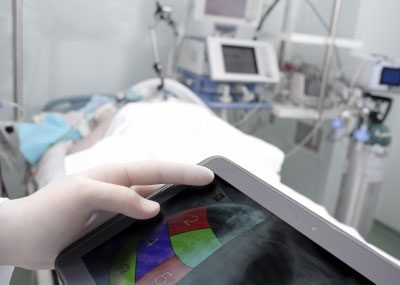
With new levels of monitoring power and performance data, manufacturers can provide better service and preventive maintenance packages than ever. Learn how the internet of things (IoT) is transforming the way medical equipment manufacturers do business.
The healthcare landscape is changing fast and many medical device organizations are seeking ways to make improvements amidst the evolution. In an industry where knowing is half the battle, medical equipment manufacturers have a lot to gain by incorporating an IoT solution into their sales, customer service, and product support strategies.
With new technologies and competitive pressures to consider, manufacturers are forced to ask some serious questions about the future of their business: How will IoT shape how manufacturers engage with equipment after-market? How will increasing customer demands affect how medical equipment manufacturers produce and service new devices?
Making Sense of Data – How Medical Device Manufacturers Benefit from the IoT
The IoT is producing volumes of machine data businesses have never had access to before. For manufacturers, all of this additional equipment information opens a range of sales, consulting, service, and development possibilities.
Here are some of the ways medtech manufacturers will benefit from improved efficiency, productivity, cost savings, and revenue thanks for connected equipment and the tools to make sense of incoming data from that equipment:
1. Increase First-Time-Fix Rates and Grow Service Margins by Reducing the Number of Field Deployments
With greater insight into equipment performance, service technicians will be more prepared to resolve issues before they arise.
Manufacturers can set parameters on connected equipment that trigger an alert to the service organization when the machine is performing outside set parameters. With the right system to interpret what the machine is saying, this alert can relay equipment performance and repair history, customer information, warranty details, and other information the technician needs to do the job well the first time.
Eventually, as machines become more computer-like and driven by software, service teams won’t even have to make a trip to the customer site to fix an issue. They’ll be able to diagnose and repair the machine remotely.
2. Improve Customers’ Operational Efficiency
One surefire way to get on a healthcare customer’s good side: make their daily operations more efficient. Embedding IoT sensors in parts and devices is one way medtech manufacturers can help healthcare providers improve operational efficiency.
A good example is by improving medical inventory stocking efficiency. Many hospitals overstock certain inventories to prevent running out during an emergency. Because of that, supplies can go unused or expire before they’re able to be used.
By implementing solutions such as radio frequency identification (RFID) and mobile scanners connected with cloud technology, hospitals gain real-time inventory numbers and status to ensure they have what they need, where they need it, when they need it.
3. Reduce the Cost to Care for Equipment by Leveraging Predictive Maintenance
With access to machine details in real time, service providers will increase machine availability and uptime because preventive IoT data makes field service actionable. In other words, with continuous data monitoring of equipment in the field, manufacturers can make service activities proactive rather than reactive by making sure they respond to alerts and resolve machine issues before a device failure occurs.
Here’s how it works: IoT sensors in equipment activate a work order automatically when a part isn’t working right. As the work order is generated, the system orders parts and schedules a preliminary service call. When the parts arrive, a service truck is dispatched to the site to perform the PM. Each of these steps is done automatically in seconds since no human interaction is required.
Today’s Medical Developments highlights predictive maintenance as a major trend for medical device manufacturers: “U.S. manufacturers will make big investments in predictive maintenance technologies in 2015. The proliferation of better and less expensive sensor technologies combined with the trend of connected factories will allow greater opportunity to implement predictive maintenance systems that will cut downtime and boost bottom lines.”
4. Connect Devices and Optimize Patient Outcomes with Big Data
By connecting equipment through the IoT, manufacturers are able to stay connected to their machines and customers: “As these technologies evolve and IT infrastructures improve, so will the number of medical devices that are linked to them, making them ‘smarter’ and better at optimizing treatment,” said Qmed in their coverage of Big Data in the medical device space. The demand for Big Data will cause many equipment manufacturers to make use of IoT strategies in order to stay relevant.

5. Provide Additional Insight and Advice for Equipment End-Users
Data from connected equipment allows device manufacturers to offer detailed advice to equipment end-users. With this additional machine information to support their suggestions, manufacturers can function more like trusted equipment consultants and sell that consulting time and value as part of a service package.
In a connected world, strong service offerings more important than ever. IoT allows manufacturers to offer additional services that go along with the product when they sell it.
6. Sell a System of Devices and Services Rather than Individual Devices

(source: Deloitte University Press)
Manufacturers can now offer a package of connected equipment and related services that optimize overall results. Smart, connected equipment is shifting the OEM business model from one based on selling products one-by-one to selling a system of products, sensors, and data to help machine users run a more efficiently.
7. Ensure Machines are Used Equally
Keeping equipment running is the major priority in the healthcare industry. One way for end-users to prevent unnecessary spending on new machines is to prioritize service and make use of usage data from by connecting equipment through the Internet. IoT sensors reveal how long, how often, and how well machines are being used. This means that if one piece of equipment is continually overused, while another is rarely placed in the rotation, hospitals can make adjustments so they receive equal wear.
In addition, service organizations can advise their healthcare customers when the best equipment scheduling times are by using a cloud-based software as a scheduling management tool.
8. Inform (and Improve) the Production of New Devices
In addition to improving service programs and patients’ ability to use devices more efficiently, IoT data can inform manufacturers about equipment performance to guide engineering, product, and quality improvement input. By continually monitoring equipment performance, manufacturers can fine-tune how to differentiate their products, making them more productive and useful for the end-user. For example, if a particular device tends to use resources too quickly, the manufacturer can change the design in its next iteration.
Conclusion: Customers Expect More Insight and Higher Level of Service from Med Equipment Providers
Smart, connect equipment and new product capabilities introduce tremendous advantages for medical device manufacturers incorporating an strategic IoT plan into their service solution. Not only do they experience reduced costs to maintain and support medical equipment, they’re able to increase equipment uptime and offer customers high levels of product support.
The healthcare industry is headed toward a more transparent, connected environment. Both patients and healthcare providers stand to gain from continuous access to increasingly connected devices, and they’ll be willing to pay for it. By keeping equipment functioning and providing the data that allows end-users to monitor things like patient health, manufacturers stand to see huge benefits if they’re ready to adapt to the changing business environment and new technologies to help them succeed.
Experience Field Service Automation in Action
Request a Service Pro demo for your medtech manufacturing business to see how you can use equipment data to fuel your service operation.