






Why Field Service Companies Struggle with First-Time Fix Rates (And How to Fix It)

Most service organizations review first-time fix rate one technician at a time. When a job comes back, the debrief covers what the tech missed on site.
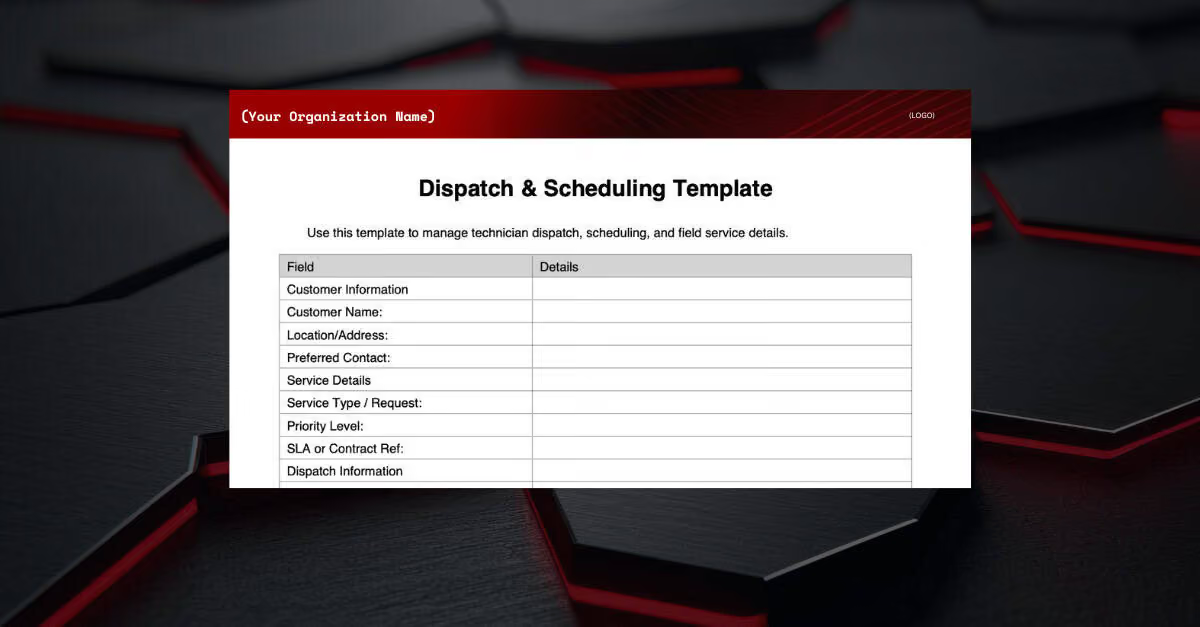
The decisions made before the truck rolled rarely come up. Dispatch sent someone without the right skills. Nobody confirmed the parts were loaded. The work order went out with the fields blank. Those failures keep the number stuck, no matter which technician takes the call.
What Is First-Time Fix Rate in Field Service?
First-time fix rate (FTFR) measures the share of service calls resolved on the first visit, with no repeat trip for the same issue. Every avoidable return dispatch adds labor, travel, parts handling, and scheduling pressure. FTFR is a useful indicator of both service cost and profitability.
How Do You Calculate First-Time Fix Rate?
Divide the number of service calls resolved on the first visit by the total number of service calls dispatched, then multiply by 100. What counts as "resolved" needs a consistent internal definition. Some organizations exclude warranty callbacks, others include them, so your number may not be apples-to-apples with published benchmarks.
Why Does First-Time Fix Rate Matter?
FTFR reflects how well the whole service system is set up before the truck rolls. Dispatch, parts, scheduling, and documentation all feed the outcome. A missed first-time fix is almost never a technician failure in isolation.
Why Is First-Time Fix Rate a System Metric?
First-time fix rate reflects every decision made before the technician reaches the site. The person holding the wrench is the last link in that chain. A job can be set up to fail before the truck leaves the yard.
Field Service News frames service performance as multiplicative. Technician capability, parts availability, information quality, and customer readiness all feed the result. A failure in any one drags down the whole. Measured per technician, FTFR captures only one of those four factors.
How Does Low FTFR Hit Service Profitability?
Each failed first visit creates another dispatch. The repeat truck roll adds labor, travel, scheduling, and parts-handling cost. It also takes a technician slot that would have gone to a preventive maintenance visit or a billable repair. Low first-time fix rate raises the cost to serve and caps how much revenue-generating work the team can take on.
Why Do Field Service Companies Struggle With First-Time Fix Rates?
The causes sit upstream of the job site, in workflows that were never built for asset-heavy service. A dispatcher matching skills to jobs from a spreadsheet and a phone list can't see what the technician will need when they arrive.
How Does Dispatch Send the Wrong Technician?
Schedulers working from spreadsheets or memory send whoever is available and nearby, not whoever has the right certifications or experience for that asset type. The result is a technician who can diagnose the problem but can't complete the repair. It is Tetris-like scheduling with no structured view of skills, certifications, or asset familiarity.
How Does Missing Asset History Slow Repairs?
On complex industrial assets like power generation equipment, commercial refrigeration, cranes, or HVAC systems, a missing service history isn't a minor inconvenience. A technician who arrives without prior service notes, install records, equipment specs, or warranty status spends an hour reconstructing what already happened instead of fixing the problem. Incomplete asset records are almost always a data entry problem upstream.
How Do Missing Parts Create Repeat Truck Rolls?
Part unavailability, whether an incorrect part or none at all, was the most cited reason for secondary visits in Aberdeen Group's 2013 field service research. Fifty-one percent of respondents named it. A technician who arrives without the required component can't finish the repair, whatever their skill level.
The problem starts before dispatch. When nobody matches the work order to likely parts or checks availability before the truck rolls, the first visit turns into a diagnostic trip. Completing the repair takes a second one.
How Does Tribal Knowledge Hold Technicians Back?
In most mid-market service organizations, one or two senior technicians hold the institutional knowledge for the most complex assets. When a newer tech hits a wall on-site, the fix is a phone call to the one person who knows that equipment. If that person is unavailable, the job stalls. As senior techs retire, that knowledge walks out with them.
How Do Weak Mobile Tools Hurt First-Time Fix?
Paper-based work orders, disconnected apps, or tools that go dark in a basement or remote site all force the same workaround: the tech calls the office, waits for someone to look something up, and loses time. Offline capability isn't optional for industrial field service. Power plants, manufacturing floors, and refrigeration rooms rarely have reliable cell coverage.
How Do Disconnected Systems Break Field Execution?
When the field service platform and the ERP don’t talk to each other, information falls through the gap. Contract terms don’t reach the technician. Warranty coverage isn't visible at dispatch. The technician closes a job, but the back office can't invoice it without calling the tech back for missing details. Prospects describe manually re-keying serial numbers, contract dates, and billing data between systems, living in what one called "an island of automation."
What Does a Low First-Time Fix Rate Cost?
A missed first-time fix costs more than the repeat truck roll. In Aberdeen Group's 2013 research, organizations above 80% first-time fix grew service revenue 6.2% year over year. Those below 80% grew 1.6%.
How Do Repeat Truck Rolls Drain Capacity?
Every technician hour spent on a repeat visit is an hour that can't go to new work. At scale, a low first-time fix rate shrinks the effective workforce, not because headcount dropped, but because available capacity is consumed by rework. The same dispatcher running Tetris with today's new calls is also trying to fit in yesterday's unresolved jobs.
How Do Repeat Visits Hurt Customer Satisfaction?
Customers don’t track first-time fix rate. They track whether their equipment is running. A second visit signals that the first visit failed, and in industries where downtime is expensive, that signal matters.
How Does Poor Closeout Create Revenue Leakage?
When a technician closes a work order with missing fields, billable work drops off the invoice. Warranty coverage nobody verified at dispatch gets written off after the fact. Parts pulled from truck stock and labor hours with no record never get charged. Waukesha-Pierce Industries (WPI), a heavy equipment dealer, recovered seven figures in warranty reimbursements within a year of moving labor and parts capture into Service Pro and reporting it to the back office at job close.

How Can Field Service Teams Improve First-Time Fix Rate?
First-time fix rate improvement follows the order of a job lifecycle: data quality before dispatch, dispatch before the truck rolls, execution at the job site, and review after the job closes.
Clean Up Asset and Work Order Data
Every job starts from the asset record. When that record is incomplete or wrong, dispatch and parts planning work from bad information. Audit each record for install date, full service history, equipment specs, and warranty status. Set work orders to pull that data automatically. Dispatch shouldn't have to retype it.
Match Skills, Parts, Location, and SLA
A technician who is close but lacks the right certification is the wrong choice. A technician with the right skills but no matching parts on the truck is also the wrong choice. Build a dispatch checklist or use scheduling software that surfaces all four variables at once, because SLA urgency changes the calculus: a priority-one call at a power generation site isn't the same decision as a routine PM visit.
Check Parts Before the Job Is Scheduled
Parts verification should happen at scheduling, not at the job site. Before a work order is dispatched, confirm that the required components are either on the technician's truck or can be staged for pickup. This requires a work order that specifies likely parts based on the asset and failure type, and a parts inventory system that reflects actual van stock in real time.
Put Service History in the Technician's Hand
The technician should arrive knowing what was done to this asset before: last service date, parts replaced, known issues, open recommendations. On a complex industrial asset, that prior history is the difference between a technician who diagnoses in minutes and one who spends an hour reconstructing what already happened. Mobile access to complete asset history, available offline, closes this gap.
Use Checklists, Photos, and Service Summaries
Structured closeout documentation forces complete job capture before the technician leaves the site, and it creates the service history the next technician will rely on. Digital checklists, required photo capture, signature capture, and auto-generated service summaries replace the incomplete paper notes that delay invoicing and leave asset records blank. For regulated industries, this is also where EPA refrigerant-tracking and safety-inspection records live.
Review Missed First-Time Fixes Every Week
Once a week, review every job that needed a second visit. Cover why it failed, what broke down upstream, and who handled the original dispatch. Patterns show up fast. One asset type generates callback after callback. A dispatch rule keeps mismatching skills. Other repeat visits trace back to a part that runs short or a technician who needs more training. Keep the meeting short and the cadence fixed. The service manager, dispatch lead, parts coordinator, and a senior technician should all attend.
Where Do Field Service Software and AI Fit?
The fixes above require data to flow between systems that are currently disconnected in most mid-market service organizations. Scheduling needs to see skills, certifications, van stock, and asset location. Mobile access needs to pull from asset records and work orders. Invoicing needs to close from field data without manual re-entry.
Connect Dispatch, Mobile, Parts, Assets, and ERP
An ERP-agnostic field service management platform connects these layers without requiring the organization to replace the back-office systems it already runs on. Service Pro by MSI Data integrates natively with Sage 100, NetSuite, Epicor Prophet 21, and Microsoft Dynamics Business Central, and MSI Data has focused solely on field service management for more than 15 years.
A connected platform addresses each breakdown point.
- Dispatch enables skill matching, SLA prioritization, and parts verification in a single scheduling view.
- Mobile tools provide offline-capable access to asset history, work orders, and service documentation at the job site.
- Parts management includes real-time van stock tracking and parts-to-job matching before the truck rolls.
- ERP sync ensures work order data flows to invoicing without manual re-entry or double data entry.
Use AI-Guided Job Prep at the Point of Work
Service Pro adds layers of intelligence to the platform. The first, Field Execution, puts the best technician's knowledge into every technician's pocket. Its Job Prep Brief delivers asset context, service history, and prior technician notes before the job, grounded in the customer's own asset records, work order history, and equipment specs. A generic large language model has none of that context.
Key capabilities:
- Job Prep Brief delivers asset context and prior service notes before the technician arrives on-site.
- Real-time diagnostic guidance allows the technician to query the system mid-repair using voice, text, photos, or uploaded documents.
- Customer data grounding means responses pull from the organization's own manuals, service history, asset records, and work order data.
- A Forward Deployed Engineer is included with every AI trial, because adoption is an organizational effort, not just a login.
Frequently Asked Questions
Who Owns First-Time Fix Rate?
First-time fix rate is a shared metric: dispatch, parts, scheduling, and field execution all contribute to it. Assigning it solely to technicians misses the upstream failures that determine most outcomes before the truck rolls.
Should Missing Parts Be Counted Separately from Technician Skill Gaps?
Tracking the reason behind each missed first-time fix gives service leaders a cleaner picture of where to intervene. A single first-time fix rate number without a breakdown of root causes makes it hard to know which fix will move the number.
How Often Should Service Leaders Review Missed First-Time Fixes?
A weekly review cadence catches patterns before they compound, and patterns in repeat visits by asset type, technician, or job category surface faster when reviewed close to the date the job closed.
Can AI Improve First-Time Fix Rate Without Disrupting Existing Workflows?
AI tools built on a service organization's own asset records, manuals, and work order history add guidance at the point of work without requiring technicians to change how they document or close jobs. The adoption barrier is lower when AI operates inside the platform technicians already use, rather than as a separate tool requiring a new login.
What Asset Data Has the Biggest Impact on First-Time Fix Rate?
Prior service notes, installed parts history, known failure patterns, and equipment specs for a specific asset give a technician the fastest path to diagnosis. The service history tied to that specific serial number is what separates a cold start from an informed repair.
See what the wait between a finished job and a sent invoice is costing you.
Run the numbers