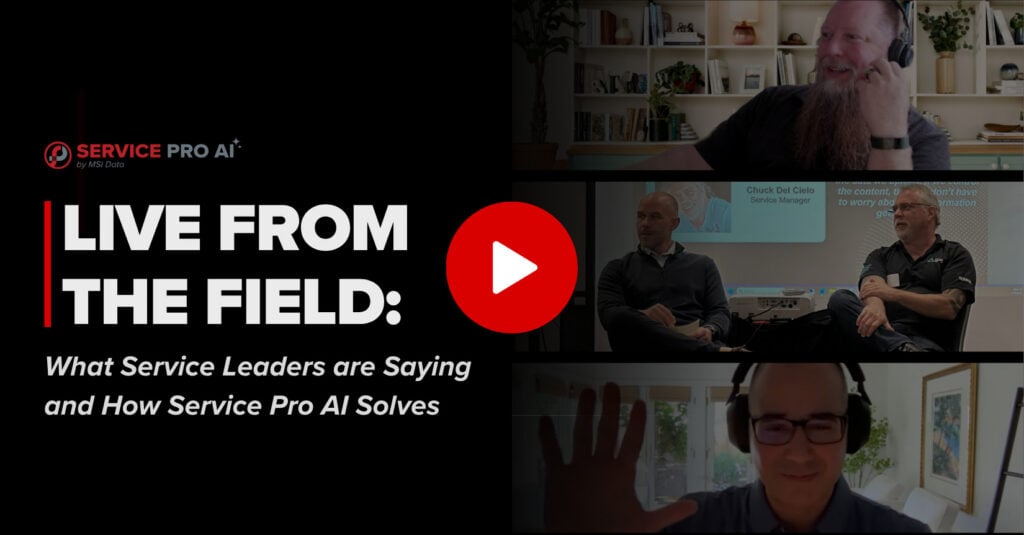

Recently, we’ve been spending a lot of time talking with field service leaders, and the conversations have been some of the most candid we’ve ever had. Service managers, operations directors, dispatchers, and business owners from across the country have been telling us, without a filter, what’s actually going on in their organizations. What’s not working. What they’ve tried. What they need.
Three themes keep coming up in every room that reflect the problems people are living with every single day. And they’re exactly the problems Service Pro AI was built to solve. Service Pro AI is a closed, enterprise AI system that works from your own data, your manuals, and your service history, to help field techs work smarter, get better context before jobs, and close the gap between what happens in the field and what ends up in the system.
We’re also sharing what Service Pro AI is doing about it. Not in theory, but in practice, with real customers who are already in the middle of it. Keep reading to hear comments and challenges from real field service leaders, including Chuck Del Cielo, Service Manager, who joined us for an ROI Fireside Chat, and Shawn Tackett, Director of Houston Field Services at Relevant Solutions, who sat down with us for a customer spotlight. Their stories are honest, practical, and well worth your time.
Let’s get into it.
1. The Documentation and Invoicing Gap Is Costing You More Than You Think
One service manager said it as clearly as anyone has: his vision is for techs to complete the majority of the work order in the field and take it all the way to the completed invoice stage with minimal back office intervention.
A tech finishes a job. Notes don’t get entered, or they get entered three days later with half the detail missing. A digital inspection form gets skipped entirely. A work order sits in limbo because someone in the back office is still chasing down what actually happened on site. The invoice that should have gone out the same day is now a week old and still incomplete.
The numbers behind this are real. One field service leader shared that his average time to invoice is 17 days. Others described cases stretching over a month. One situation that came up involved a multi-day job where the tech was too busy to answer the back office’s clarifying questions, and the follow-up stretched on for weeks. At that scale, shaving even a week off that average represents a meaningful cash flow impact.
Delayed documentation isn’t just an annoyance. It’s a direct hit to cash flow, customer experience, and your team’s time.
Here’s what makes it harder to fix than it looks: the problem usually isn’t that techs don’t care. It’s that the way documentation currently works is friction-heavy enough that it gets pushed to later, and later becomes never. Notification fatigue is real. Techs tune out app alerts. Texts get ignored. Most don’t open emails. You can keep prompting them, but if the tool itself is inconvenient, the prompts don’t change the behavior.
The dispatch side of this is just as painful. Techs not clocking out of jobs. Statuses not getting updated. Dispatchers staring at a screen with four jobs open under one tech at the same time, across multiple locations, with no way to know what’s actually happening. One service manager’s story started with bringing their entire company onto Service Pro from paper, where they had previously been mailing their service tickets in by UPS once a week. For businesses like that, the gap between the field and the back office isn’t just inefficient, it’s archaic.
And then there’s the knowledge that walks out the door. Every shop has a senior tech who everyone calls when they’re stuck. That person carries years of institutional knowledge in their head. They know the equipment, they know the quirks, they know what to check first. The challenge is that knowledge doesn’t automatically make it into the system. When that person retires, that knowledge feels impossible to replace.
Service Report Automation within Service Pro AI is designed to start closing that gap. It generates clean, professional appointment summaries automatically from what the tech captured on site, without requiring the tech to sit down and write it up. Shawn Tackett at Relevant Solutions put it plainly: not every technician is great with words, and talk-to-text can produce some “colorful results.” Service Pro AI cleans that up, turning what the tech captured into a professional, concise summary without anyone in the back office having to rewrite it.
Tony, one of Shawn’s technicians, put it this way:
“As soon as I made the first summary with Service Pro AI and saw how it formatted and how professional it looked, I really liked it. I was very impressed with that.”
— Tony Dulin, Technician at Relevant Solutions
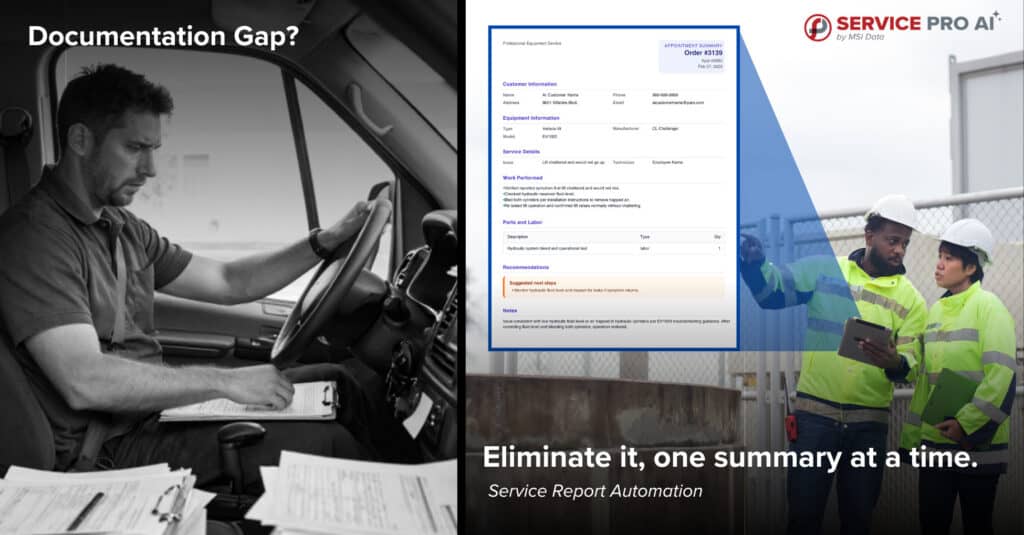
The vision field leaders are asking for goes further. They want voice-activated inspection completion. A technician talks through a comprehensive inspection step by step, hands-free, and the AI captures every response and generates the completed report automatically. No gloves off. No phone screen typing. No skipped fields. Service Manager Chuck Del Cielo described it in vivid detail: a tech with noise-cancelling headphones, walking through a generator inspection, talking to the AI as they go, taking pictures when prompted, and ending up with a completed inspection report that gets emailed to the customer automatically before they ever leave the site.
On the invoicing side, the ask is just as clear. AI handling the work write-up while the tech is still on site, so the work order is ready to move to invoice before the truck even pulls away. No back office phone calls. No chasing. The gap between job completion and invoice out finally closes.
One concern that comes up every time: will AI make it too easy for techs to skip the thinking? Here’s what we’re hearing from service leaders: their experienced technicians are retiring, and their knowledge needs somewhere to go. Done right, AI isn’t a shortcut around expertise. It’s how you capture it and make it available to everyone on your team. The goal isn’t to remove the thinking. It’s to make sure the thinking doesn’t disappear when your best people do, and strengthen your entire team before that happens.
2. Context Before the Job Is Just as Important as the Job Itself
We’re hearing this from leaders all the time; how does Service Pro AI help my technicians go into a job prepared, and why is it better than any other option?
The answer is: context matters. The right context + the right tech + the right job + the right time is the new formula for success.
Chuck Del Cielo’s team services power generators for critical facilities, hospitals among them. When a generator goes down and is waiting on parts, it can sit that way for two to three months. And yet, without the right context surfaced at the right moment, a dispatcher can still schedule a maintenance tech to go out to it, resulting in a confused technician and a costly truck roll. When asked how much a typical truck roll costs, service leaders have said anywhere from $175 to over $1,000 per truck roll. That’s a significant cost to risk from one misjudged ChatGPT answer.
What could this look like in the field? We’ve heard this scenario described before: a tech shows up to a customer site with no idea what was tried last time, what parts have already been swapped, or what the service history looks like. They have no choice but to go into the appointment with no context. The customer, who spent 20 minutes on the phone before the appointment describing the problem, now has to describe it all over again because the tech didn’t, or couldn’t, review anything before walking in. The result? Wasted time, money, and a five-star review that drops to four.
These are real, daily problems that service orgs everywhere are experiencing. When people share these challenges with us, they’re not complaining; they’re asking for a solution.
The upcoming Job Prep Brief feature is designed to be that solution. Before a tech rolls, they get a summary of the job context pulled together automatically: relevant service history, notes, previous inspection results, what’s been tried before. Not buried in a system they have to navigate. Not requiring a call to the dispatcher. Right there, in a brief they can read or have read to them in under a minute, before they ever get out of the van. They grab the right parts. They know who they’re talking to. They walk in ready.
Relevant Solutions is a company that understands this challenge at real scale. They service everything from small equipment at local supply stores to 10,000-horsepower compressor stations across the country. Their technicians work on complex, high-stakes equipment, and the difference between showing up prepared and showing up cold is significant. Shawn Tackett, Director of Houston Field Services at Relevant Solutions, champions building out the knowledge base inside Service Pro AI specifically so that techs can access the right information before and during a job, not just after. “The work we’re putting in now is going to benefit us later.” — Shawn Tackett, Director of Houston Field Services, Relevant Solutions

3. The Data Privacy Difference: Two Experiences, One Solution
Every room has someone who asks the same question: how is Service Pro AI different from ChatGPT?
We love this question. It starts with privacy and accuracy. Data security comes up as an initial question in nearly every conversation we’re having. For companies where institutional knowledge and competitive advantage are tied together, knowing exactly where their data lives and who can access it is critical.
Here’s two real-world examples of Service Pro AI protecting data privacy and accuracy.
1. When Service Manager Chuck Del Cielo began fielding complex troubleshooting calls from technicians, he ran a test, starting with Service Pro AI. One call involved a reported injector fault. Working through the issue with Service Pro AI, Chuck traced the real problem to a fuel pump on the same circuit, where a low-voltage issue was triggering the fault code. Then, he ran the same scenario through ChatGPT, which told him to replace the injectors. That would have been the wrong fix, a wasted part order, and a frustrated customer.
What a Real Customer Learned from Going All-In on Service Pro AI is our fireside chat with Chuck Del Cielo. It covers his hands-on experience using Service Pro AI in the field, his direct comparison to ChatGPT, and what the ROI of getting the right answer the first time actually looks like. If you’re skeptical about AI in field service, Chuck’s story is the honest, no-hype version of why it matters.
The difference isn’t just accuracy. It’s grounding. Service Pro AI only pulls from data you control: your equipment manuals, your service history, your SOPs, your knowledge articles. Not the open internet. Not a guess. Trusted information built from content you verify, approve, and upload with the help of your Forward Deployed Engineer.
This was critical for Chuck and his team. Without their content being used as the source of truth, Chuck would have sent his technician to fix a part that wasn’t really broken. Chat GPT doesn’t have the same kind of grounding Service Pro AI does, nor the field service capabilities.
“We’re getting information from the data we upload. If we control the content, then we don’t have to worry about bad information getting back.”
— Chuck Del Cielo, Service Manager
2. Field Service Director Shawn Tackett came at the same concern from a different angle. His team didn’t want their proprietary knowledge out on the internet for anyone to see, most of all his competitors.
“We don’t want our information out there for public consumption. We wanted to ensure we’re not educating our competitors, but utilizing our own knowledge.”
— Shawn Tackett, Relevant Solutions
Knowing the platform is grounded in their own data, not the web, was a main draw for Service Pro AI.
How One Fast-Growing Industrial Service Company is Building the Business Case for AI is our spotlight with Shawn Tackett at Relevant Solutions. Relevant Solutions has grown over 800% in five years, and Shawn is candid about what it actually takes to scale a service organization that fast without losing quality. He talks through the data privacy concerns his team had, how they’re using Service Pro AI today, and where he wants to take it next.
Is Service Pro AI Right for Your Team?
Service Pro AI is a good fit if your team is concerned about revenue. More specifically, how any of the following affect your service revenue: techs who don’t capture notes consistently, back office staff spending time chasing down job details before invoices can move, new technicians who need more support in the field, experienced techs whose knowledge isn’t being captured anywhere, or a growing operation where scaling quality is getting harder.
You don’t need to have your knowledge base perfectly built out to get started. Features like appointment summary generation are ready to go on day one, and you’ll have the full support of a Forward Deployed Engineer who will work alongside your team throughout the trial to make sure adoption actually happens, not just give you login and a portal link.
Start Your Free Trial of Service Pro AI
The problems field service leaders are describing aren’t new. But the tools to start solving them are. If you want to see what Service Pro AI can do for your operations, start your free trial today and find out firsthand how field service leaders across the country are getting ahead.
Start Your Free Trial of Service Pro AI
Frequently Asked Questions
What is Service Pro AI and how does it work?
Service Pro AI is a closed, enterprise AI system built specifically for field service organizations. It’s grounded in your own data, including your equipment manuals, service history, SOPs, and knowledge articles, not the open internet. That means your technicians get accurate, trusted answers based on your operations, not a guess from somewhere online.
How is Service Pro AI different from ChatGPT or other general AI tools?
General-purpose tools pull from the open internet and can confidently return wrong answers when they don’t have the right data. Chuck Del Cielo tested this directly: Service Pro AI traced a generator fault to the real root cause, while ChatGPT recommended replacing the wrong part entirely. Service Pro AI is grounded in what you’ve uploaded and configured, so the answers are accurate and specific to your equipment and workflows.
What happens to my data?
Your data stays yours. Service Pro AI is a closed system. What you upload isn’t shared publicly, isn’t used to train models for other companies, and isn’t accessible outside your organization. For companies where proprietary knowledge matters, this isn’t a detail. It’s the whole point.
How quickly can we get started?
Setup is fast. Features like Service Report Automation can be used on day one without a fully built knowledge base. MSI Data’s Forward Deployed Engineers guide your team through the process and stay engaged throughout the trial to make sure your technicians are adopting the tool and seeing real value.
Will AI make it too easy for techs to skip the thinking?
It’s a real concern and one worth taking seriously. But consider the other side: experienced technicians are retiring, and their knowledge needs somewhere to go. Service Pro AI isn’t designed to replace thinking. It’s designed to capture institutional knowledge and make it available to every tech on your team, especially the ones still building their expertise. The goal isn’t to remove the thinking. It’s to make sure the thinking doesn’t disappear when your best people do.
What’s coming next for Service Pro AI?
Voice-activated inspection completion and the Job Prep Brief feature are both on the roadmap, shaped directly by feedback from customers and field leaders. Warranty claim automation and deeper ERP integrations are also in development. The feedback loop between customers and the MSI Data development team is fast by design, so what customers ask for today shows up in the product quickly.