
A single backordered compressor can push a commercial installation back two months. A chiller ordered today for a new distribution center might not arrive for the better part of a year. For HVAC contractors and the facility owners who depend on them, this is the reality of doing business in 2026: the equipment is more advanced than ever, and getting it where it needs to be has never been harder.
Most HVAC companies respond to this by scrambling. A part goes missing, someone starts calling around, and the job sits half-finished while the office tracks down an answer. That reactive posture works until it doesn’t, and in a supply chain this volatile, it doesn’t work often enough. The alternative is visibility: knowing what you have, what’s coming, and where your exposure sits before a shortage turns into a stalled project.
This guide breaks down the anatomy of the commercial HVAC supply chain, the disruptions currently squeezing it, and the strategies and systems that let service organizations operate from a position of control instead of catching up.
What Is the Commercial HVAC Supply Chain?
The commercial HVAC supply chain is the interconnected network of raw material suppliers, equipment manufacturers, distributors, and contractors that sources, builds, and delivers the heating, ventilation, and air conditioning systems used in commercial and industrial buildings.
Inside the HVAC Supply Chain: Network Structure & Key Players
The HVAC supply chain operates as a layered network, and each tier depends entirely on the one before it. A shortage or delay at any single point ripples downstream, often reaching the customer long before anyone identifies where the disruption started. Pinpointing where your own operation sits inside that chain is the first step to understanding where you’re exposed.
Raw Material Suppliers
Every HVAC system begins with raw inputs: aluminum, steel, copper, specialized refrigerant chemicals, and semiconductors for control boards and sensors. Scarcity or price volatility at this tier delays everything downstream, since manufacturers cannot build coils, compressors, or control boards without these materials in hand.
HVAC Manufacturers
Manufacturers assemble those raw inputs and components into finished equipment: chillers, air handlers, rooftop units, and custom commercial systems. Commercial systems are frequently custom-engineered and built to order, which is exactly what makes their lead times so vulnerable to disruption. There’s no shelf inventory to fall back on when a component runs short.
Distributors and Wholesalers
Distributors hold and release stock, bridging the gap between factory output and the local contractors who need parts and equipment on-site. Distributor inventory depth is often the difference between a same-week fix and a multi-month wait, which makes strong distributor relationships one of the most underrated assets a contractor can build.
HVAC Contractors and Engineers
The final tier includes the mechanical engineers, architects, installers, and service technicians who handle integration, commissioning, and ongoing lifecycle maintenance. Every upstream disruption eventually lands here, and this is where the customer relationship is won or lost regardless of what caused the delay further up the chain.
Current HVAC Supply Chain Issues Reshaping the Industry
Understanding the players in the chain is only half the picture. Service leaders also need to understand the specific pressure points currently squeezing the industry, because each one changes how procurement, quoting, and project planning need to work.
Global Logistics and Extended Lead Times
Commercial HVAC manufacturing leans heavily on overseas components and specialized electronics, which makes the supply chain vulnerable to port congestion and shipping bottlenecks. A 2026 industry analysis of global container shipping found wait times stretching to 15 days across parts of Africa and 20 to 36 days at select Asian and European ports during peak periods. On the domestic side, the American Trucking Associations projects the U.S. will be short roughly 82,000 truck drivers in 2026, a gap it estimates could exceed 160,000 by 2031 if current trends hold.
The result shows up directly in equipment availability. Industry reporting puts lead times for large custom air handlers and central plant components at 16 to 28 weeks from major manufacturers, and Trane Technologies reported a record $7.8 billion backlog at the close of 2025, converting on a 9-month average order-to-ship timeline for its applied commercial and data center chiller business. For a facility owner planning a capital project, that kind of lead time is difficult to predict and even harder to plan around.
Volatile Material and Equipment Costs
Copper, steel, and aluminum prices have surged since 2020, and that volatility flows straight into the budgets of large capital replacement projects. According to the U.S. Bureau of Labor Statistics, HVAC equipment prices have risen roughly 40% since early 2020, while domestic metal producers have raised selling prices by more than 42% over the same period. ACHR News reports that the average commercial system price has nearly doubled over that stretch, making it difficult to quote a job accurately when material costs can shift underneath you between the bid and the purchase order.
Labor Shortages Across the HVAC Industry
The skilled-labor shortfall hits both ends of the chain. Fewer manufacturing and transportation workers slow production and delivery, and fewer qualified field technicians slow installation and service. Mar-Hy Distributors reports that labor now represents nearly 34% of total HVAC business costs, with materials accounting for close to 39%. As experienced technicians retire faster than new ones enter the field, the shortage extends project timelines while driving up costs as companies compete for a shrinking pool of qualified talent.
Tariffs, Regulations, and Refrigerant Transitions
Tariffs and trade policy add sourcing uncertainty on top of everything else, complicating decisions about where to source components and how to price them with confidence. Layered on top is a regulatory shift: the AIM Act targets an 85% phase-down of hydrofluorocarbon refrigerants by 2036, and low-GWP alternatives like R-32, R-454B, and R-290 are now standard in new equipment design. That transition forces manufacturers to redesign compressors and systems, and it makes sourcing parts for older units increasingly difficult as production shifts toward the new refrigerant standards.
Surging Demand — Including the Data Center Boom
Demand is outpacing supply across the industry, driven by aging infrastructure replacement, electrification initiatives, and the seasonal nature of cooling demand. Mordor Intelligence projects the global chiller market will grow from roughly $13.2 billion in 2026 to nearly $17 billion by 2031, and identifies data center owners as the clear growth pacesetter within that market, expanding at more than 6.5% annually as hyperscale and AI-driven facilities specify redundant, high-capacity chiller systems.
That surge is consuming a disproportionate share of manufacturing capacity. Trane’s applied solutions bookings, which cover the large-scale chiller and thermal management systems used in data centers and commercial buildings, jumped more than 120% year over year for two consecutive quarters heading into 2026. Every unit committed to a hyperscale build is a unit no longer available for a commercial contractor’s next project, and that competition for factory slots lengthens lead times for everyone.
How HVAC Supply Chain Disruptions Impact Commercial Projects
Commercial projects are uniquely exposed to supply chain disruption compared to residential work, largely because of scale. Large systems require a much higher volume of components, from ductwork to advanced controls to multiple coordinated units, which makes them more sensitive to a single shortage anywhere in that mix. One delayed part or unit can stall an entire project, cascading into tenant move-in dates, missed construction milestones, and budgets that no longer reflect reality.
The scale of that risk is significant. A single backordered air conditioning unit can push a commercial project back six to eight weeks. On the data center side, a cooling buildout can hinge on a chiller order sitting inside a nine-month manufacturer backlog, with no meaningful workaround once the order is placed. In commercial HVAC, supply chain risk is project risk, and project risk is customer relationship risk.
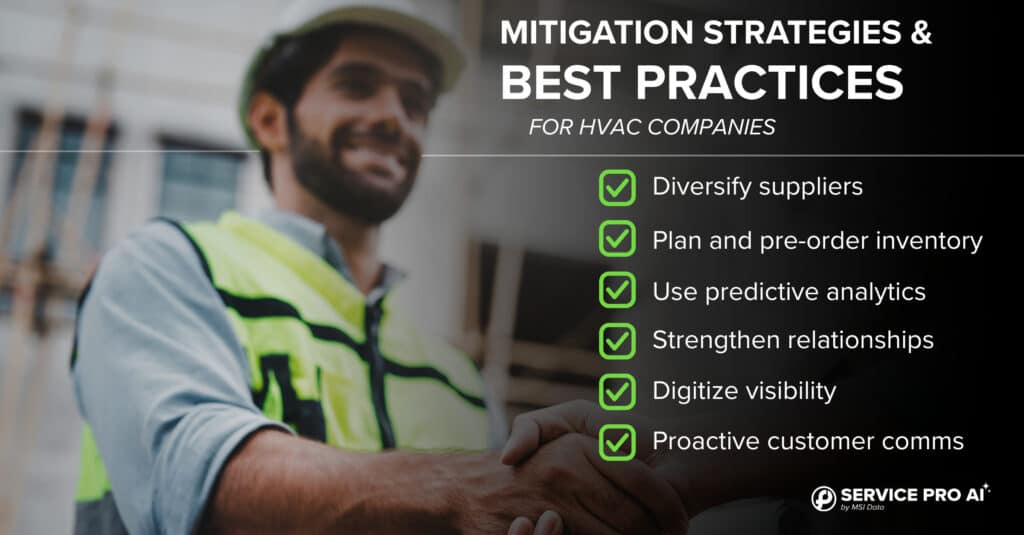
Mitigation Strategies & Best Practices for HVAC Companies
None of this is going away soon, and businesses need to not only function, but succeed, until then. Here’s a practical playbook for turning supply chain volatility from a threat into a competitive advantage, and the software layer that makes each strategy possible at scale.
- Diversify Suppliers and Build Redundancy
Depending on a single supplier or distributor is the core vulnerability behind most supply chain failures. Building a pre-vetted network of multiple regional suppliers, and identifying alternatives for your most-used parts and equipment, means you can pivot quickly instead of scrambling to vet a new vendor mid-project. Keeping vendor and pricing data centralized rather than scattered across inboxes is what makes that pivot fast instead of frantic.
- Pre-Order Critical Equipment and Plan Inventory Strategically
Pre-purchasing long-lead-time equipment like chillers, air handlers, and controls early in the project lifecycle is now standard practice on large commercial and data center jobs. Just-in-time inventory only works when the supply chain is calm. In a disrupted environment, strategic safety stock of high-turnover parts protects uptime, and the tradeoff worth weighing is bulk-buy discounts against the cost of carrying that extra inventory. Reserving pre-ordered equipment against a specific work order the moment it arrives keeps it from being pulled for another job before the scheduled installation.
- Use Predictive Analytics and Demand Forecasting
Historical service and usage data reveal seasonal and localized demand trends, letting HVAC companies anticipate what they’ll need before they need it. Predictive, data-driven purchasing is the upgrade from gut-feel ordering, and it’s exactly the kind of pattern AI field service software is built to surface at scale, turning BI dashboards into an early warning system for what’s about to run short.
- Strengthen Supplier and Manufacturer Relationships
Staying in regular contact with suppliers and manufacturers pays off in ways that are easy to underestimate. Sharing upcoming project needs, asking about inventory levels, and tracking pricing trends earns priority access, better pricing, and faster issue resolution. Strong vendor relationships protect a company when a single supplier runs short.
- Digitize Inventory, Parts, and Asset Visibility
You can’t manage a supply chain you can’t see. Moving off spreadsheets and paper to real-time, digital inventory and parts tracking gives leaders a live view of what’s on hand across trucks and warehouses, so they can anticipate shortages, prevent over- and under-stocking, and make data-driven purchasing decisions even when the broader supply chain stays unpredictable. This is the strategy that turns every other item on this list into a daily habit instead of a good idea.
- Communicate Proactively With Customers
Transparent communication with building owners and facility managers about delays and timelines preserves trust and loyalty even when the news isn’t good. Proactive status updates, realistic timelines, and alternative equipment options go a long way toward keeping a customer relationship intact through a disruption that was never in your control to begin with.
Build a Resilient Commercial HVAC Operation With Service Pro
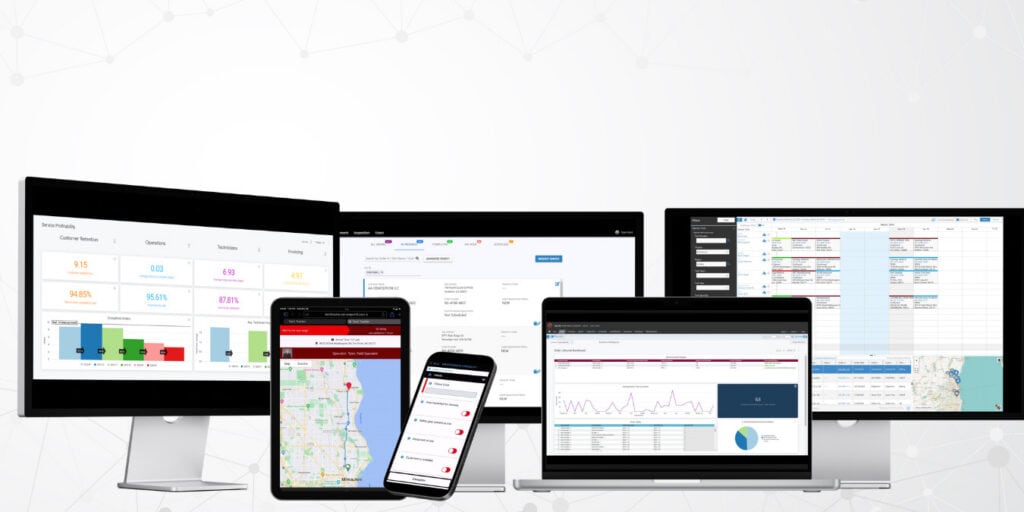
Software is the connective tissue that turns a fragile supply chain into a resilient one, and Service Pro is built to be that operational command center. It’s an asset-centric field service management platform built exclusively for commercial and industrial equipment service organizations, including HVAC contractors, and every mitigation strategy above maps to a specific capability inside it.
Real-time service parts and inventory management gives your team visibility into parts across every truck and warehouse, forming the digital backbone for strategic inventory planning. Asset management and complete system histories mean your team knows every system’s equipment specs, refrigerant type, install date, warranty status, and service history, so the right parts get identified before the truck ever rolls. Predictive and preventive maintenance scheduling lets you plan and bundle work around equipment needs instead of reacting to emergency breakdowns, and built-in BI dashboards surface demand patterns, parts-not-available rates, and seasonal trends to drive smarter purchasing decisions. Integrations with ERP systems like Epicor Prophet 21, NetSuite, Microsoft Dynamics Business Central, and Sage 100 sync purchasing, inventory, and financial data into a single source of truth, and Service Pro AI gives technicians grounded, in-the-field intelligence that helps them resolve more issues on the first visit, even when parts constraints are working against them.
Waukesha-Pearce Industries (WPI), a construction dealer and service provider with nearly a century in the industry, partnered with Service Pro to move from paper-driven workflows to a fully digital service operation. Technicians who once lacked access to equipment history now have immediate visibility into asset records and job context on every call. “It’s amazing to be able to assign work orders between departments and make decisions to close them faster,” said District Service Manager Chad Ticknor. The shift contributed to stronger customer satisfaction and seven-figure claim recovery savings for the organization.
Real-time visibility into parts, assets, and operations is what separates the firms that weather supply chain volatility from the ones that get stalled by it. If you’re ready to move from reactive scrambling to a proactive, data-driven operation, schedule a free demo or contact our team to see what Service Pro can do for your business.