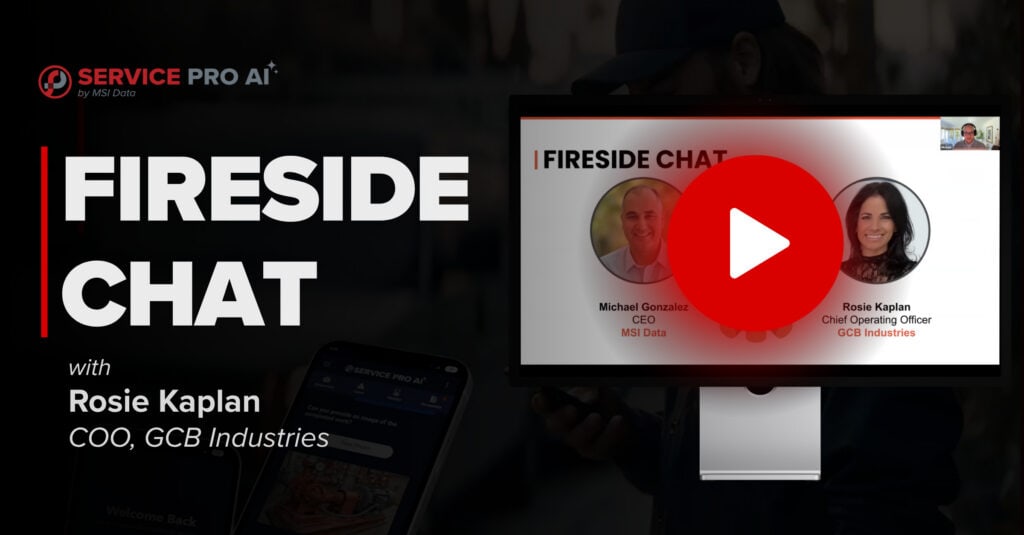

Everyone’s talking about AI. But talking about it and actually building it into a national service operation are two very different things. Rosie Kaplan, COO of Gulf Coast Boiler (GCB Industries), is doing the latter.
GCB Industries is a national boiler service company serving both commercial and industrial customers across the U.S. The scope of their work is wide. Some jobs are smaller routine service calls. Others are multi-million-dollar projects. Their field teams reflect that range too, from junior technicians just getting started to highly advanced specialists who handle the most technical jobs.
Rosie joined us for a candid fireside chat during a recent Service Pro AI webinar, and her energy for AI was clear from the moment she sat down. Her reasoning was simple: if GCB didn’t find a way to bring AI into the organization, the company risked getting left behind. That’s what pushed her to start exploring Service Pro AI, and it’s the same eagerness that made her such a strong partner throughout the trial. What she’s learned about training technicians, trusting AI output, and building a real trial partnership is worth hearing straight from her.
You can watch a short clip from the conversation below, but keep reading for the highlights. Want the full conversation? Fill out the form to access the complete fireside chat recording.
Why Service Pro AI?
Two things stood out to Rosie right away.
The first was Service Report Automation, managed by the Appointment Agent. As she put it, taking what technicians were already doing in the field and summarizing it for them removed a task nobody enjoys and nobody does particularly well under time pressure.
The second was training. GCB, like a lot of service companies, has junior technicians who need real field experience but can’t always be billed out on jobs until they’re ready. Rosie saw an opportunity to load GCB’s own manuals and technical information into Service Pro AI so junior techs could troubleshoot on their own instead of calling a service manager or technical support every time they hit a snag.
Rosie described exactly the kind of gap Service Pro AI was built to close: “Knowing that we could input manuals and all the information that we would know that potentially they would be needing… aside from always having to call our service manager.”
That kind of self-service troubleshooting only works if the technicians can actually trust what the AI tells them, which is exactly what Rosie brought up next.
Why a Closed, Grounded System Matters
Rosie isn’t the first to ask this critical question: where does the information actually come from?
Service Pro AI is a closed system, so it isn’t searching the open web. For GCB, it draws only from the data bank they’ve built and uploaded themselves, including manuals, SOPs, and documentation. That distinction matters. General AI tools can confidently generate answers that sound right but aren’t tied to any real source — a problem known as hallucination, and one both Rosie and the Service Pro AI team have seen firsthand. Scoping the AI to sources GCB actually trusts dramatically narrows where those answers can come from, which is what makes it suitable for technical, high-stakes work like boiler service.
Grounding an AI in trusted documents reduces the risk of a wrong answer, but it doesn’t remove the need for a technician’s judgment. That’s why the source matters: when the AI points to the manual or SOP behind its answer, the tech in the field can verify it, rather than take it on faith. Learn more about how to know if you can trust AI in the field here.
Job Agent in Action
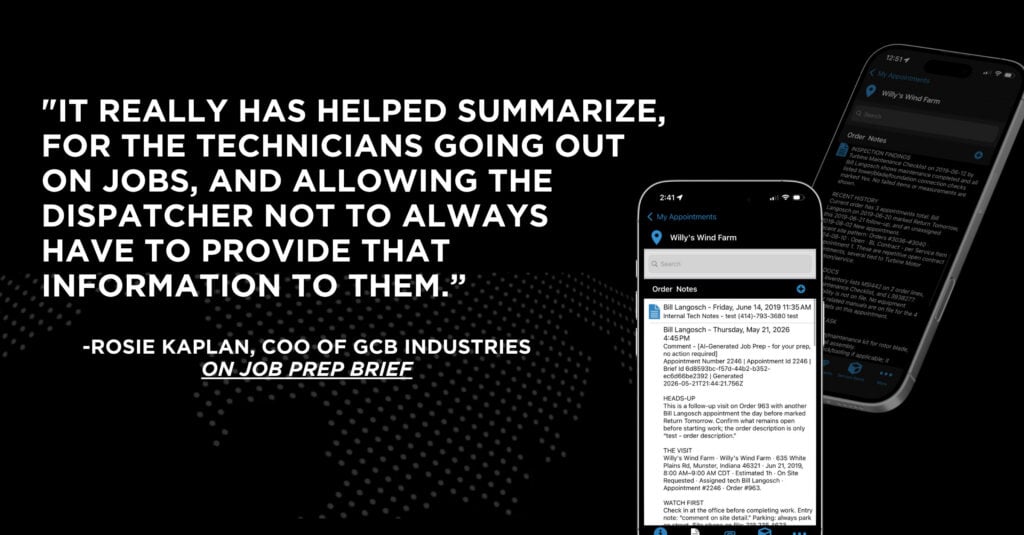
Rosie has also had hands-on experience with the Job Agent’s Job Prep Briefs since it launched. Before it, GCB technicians would regularly call dispatchers just to find out what happened during previous inspections, or even who the last technician on a job was. That information existed, but it lived in a database, disconnected from the person who actually needed it before walking into a job.
In the Job Prep Briefs, that context now shows up automatically, or techs can ask the AI agent directly for what they need before heading out.
“It really has helped summarize, for the technicians going out on jobs, and allowing the dispatcher not to always have to provide that information to them,” Rosie explained.
There’s a customer-facing benefit here too. When a tech walks in already knowing the history, the customer doesn’t have to repeat themselves. Nobody wants to explain the same problem twice to two different people from the same company.
The High-Touch Trial Partnership
One theme Rosie kept coming back to was how closely GCB has worked with the MSI Data team throughout the trial. She described it as one of the most rewarding parts of the process: giving feedback and actually seeing it acted on.
“The AI world is constantly changing, and I think that you guys are very aware of that and have been providing us with the feedback that we give you, really taking that in and implementing it. That’s been a really cool piece of working so closely with you guys,” Rosie said.
That fast feedback loop isn’t unique to GCB. Fixes and improvements that would typically take months at most software companies often happen in a matter of days here, something Rosie noted has made the partnership feel genuinely collaborative rather than transactional.
What’s Next: Custom Service Report Templates
Asked what she’s most excited about next, Rosie didn’t hesitate. She’d like to see Service Pro AI get closer to GCB’s exact service report format, including the specific fields a combustion report requires.
Her vision: technicians input their work performed in the field, and if they miss a required field, like whether material was used, the AI prompts them for it on the spot. GCB would upload its own templates, and the system would use those templates to guide technicians through the report as they go.
“It would take the template that we would input into the data bank… and then triggering that to prompt the technician,” Rosie said.
That kind of prompt-driven reporting speaks directly to something every service company deals with: the back-office cleanup that happens after a job wraps. Rosie pointed out that most service companies have at least one person whose job is untangling incomplete reports before they can go out as invoices. Reducing that cleanup means faster, cleaner invoicing and less time spent chasing down details after the fact.
It’s customer feedback like Rosie’s that helps shape the direction we go with Service Pro AI. Want your voice to be heard? Request your free trial of Service Pro AI here.
Hear the Full Conversation
Rosie’s story is one we think every field service leader should hear, especially if you’re managing a mix of junior and senior technicians or wondering whether your team can afford to wait on AI. To get the full picture, watch the complete fireside chat recording here.
Start Your Free Trial of Service Pro AI
If Rosie’s story sounds familiar, whether it’s junior techs who need more support, back-office staff cleaning up incomplete reports, or simply not wanting to fall behind on AI, the best next step is trying Service Pro AI for yourself.
Our trial is different from a typical software rollout. Our Forward Deployed Engineers work directly alongside your team throughout the process, so your technicians are actually adopting the tool and seeing value, not just logging in once and moving on. Setup takes minutes, not months, and features like Service Report Automation are ready to use from day one.
Start Your Free Trial of Service Pro AI
Frequently Asked Questions
What is Service Pro AI, and how is it different from general AI tools?
Service Pro AI is a closed, enterprise AI system built for field service organizations. Unlike general-purpose tools that pull from the open internet, it only uses content you upload and control, like your manuals, service history, and knowledge articles. That means your technicians get answers grounded in your own operations instead of a guess from somewhere online.
Can Service Pro AI help train newer technicians?
Yes. While Service Pro AI can be used by technicians of any skill level, it helps organizations give junior technicians a way to troubleshoot using the company’s own manuals and technical information, instead of relying solely on a service manager or technical support team for every question.
How does Job Prep Brief help techs in the field?
Job Prep Brief automatically surfaces service history, prior inspection results, and other job context before a technician arrives on-site. That means fewer calls back to the dispatcher and a smoother experience for the customer, who doesn’t have to repeat information they already gave.
What does the trial process actually involve?
The trial is a high-touch engagement. Our Forward Deployed Engineers work directly with your to launch, gather feedback, and implement changes iteratively until we meet the business metrics you want to see improve.
Is my company’s data safe with Service Pro AI?
Yes. Service Pro AI is a closed system, so what you upload isn’t shared publicly, isn’t used to train models for other companies, and isn’t accessible outside your organization. Your data stays yours, and the answers your technicians get are grounded only in what you’ve uploaded and approved.