

Power generation service teams routinely absorb warranty costs they were never supposed to carry because no one checked coverage terms before the work order was dispatched.
WPI recovered $2.9 million in warranty claims in under a year once that check happened automatically at intake through Service Pro. That’s what enforcement at the right step actually does.
The rest of the breakdown is familiar: wrong tech dispatched, asset history missing from the work order, invoice stuck in the back office for two weeks waiting on someone to fill in the gaps, parts unavailable when the truck arrives.
Eight platforms are covered (Service Pro by MSI Data, IFS Cloud, ServiceMax, Salesforce Field Service, Microsoft Dynamics 365 Field Service, Oracle Field Service, Simpro, and BuildOps), evaluated for power generation service specifically, not field service broadly.
What is field service management software for power generation?
Field service management (FSM) software connects work orders, asset records, technician schedules, parts inventory, and customer contracts so nothing falls through the cracks between the field and the back office. For power generation specifically, that means managing planned and unplanned maintenance on generators, turbines, switchgear, and related equipment at customer sites.
Industrial power generation FSM is a different category than residential or light-commercial field service software: the assets are long-lived, the service contracts are complex, and a missed preventative maintenance or misapplied warranty costs far more than the job itself.
What features matter for power generation field service?
Your dispatcher is cross-referencing spreadsheets and making phone calls to figure out who has the right certifications and is closest to the job. Your tech arrives at a generator site without the service history. An invoice sits unsigned for two weeks after the job closed. These are the gaps that purpose-built FSM software is designed to close, and the features below are what separate a platform built for this work from a generic scheduling tool.
Asset history at the equipment level
Generator sets and turbines have long service cycles. A missed pattern in the history is a missed failure warning, which is why asset-centric FSM stores service records, serial numbers, install dates, and prior repair notes against each individual piece of equipment, not just the customer account.
- What this replaces: Paper logs, shared drives, or a phone call to the one senior tech who remembers the last repair.
- Why it matters: Without equipment-level history in the work order, every tech starts from scratch on every visit.
Scheduling and dispatch by skill and urgency
Power generation service calls range from planned annual PMs to emergency outages, and the dispatch problem is the same either way: getting the right tech with the right certifications to the right site without rebuilding the entire day manually. Skill-based dispatch assigns technicians based on equipment type, certification, and proximity, and priority routing re-sequences the board when an emergency call comes in.
Offline mobile access for remote sites
Substations, remote industrial campuses, and offshore platforms rarely have reliable cell signal. Offline-capable mobile FSM lets technicians complete work orders, capture photos, record parts used, and collect signatures without a connection, then syncs when signal returns. A mobile app that requires connectivity fails at the job site.
Preventive maintenance and inspection workflows
FSM software should auto-generate PM work orders from run-hour thresholds or calendar intervals, attach the correct inspection checklist to the job, and flag overdue PMs before they become compliance or warranty issues. A missed PM in power generation can void an OEM warranty or allow a failure that a scheduled inspection would have caught.
Contract and warranty coverage enforcement
Power generation service organizations carry complex service contracts and OEM warranty agreements that determine what labor and parts are billable. Without automated coverage enforcement at work-order intake, technicians perform covered work and bill it as time-and-materials, or absorb out-of-warranty costs without a claim.
FSM software should check contract and warranty status the moment a work order is created and flag the coverage terms before a technician is dispatched. WPI, a construction and industrial equipment service organization, recovered $2.9 million in warranty claim recoveries in less than one year after implementing this kind of coverage enforcement through Service Pro.
Parts visibility for first-time fix
First-time fix rate is the percentage of service calls resolved on the first visit without a return trip. Industry best-in-class is approximately 88%; most mid-market operations run closer to 70%, according to Aquant’s 2024 Field Service Benchmark Report. The most common cause of that gap is a technician arriving without the right part.
FSM software should show parts availability across stocking locations (warehouse, service van, supplier) at the time of scheduling, so the dispatcher can confirm the tech is loaded correctly before the truck rolls.
ERP integration without an ERP replacement
Your back-office staffer is reconciling a technician’s incomplete notes before an invoice can go out, sometimes calling the tech back to fill in the gaps. Native ERP integration eliminates that step by pushing completed work orders, parts consumption, and invoice records directly into the ERP without manual re-entry.
Service Pro connects natively to Sage 100, NetSuite, Epicor Prophet 21, and Microsoft Dynamics Business Central. The ERP-agnostic architecture means the FSM connects to the system the organization already runs, with no replacement required.
Reporting that shows margin before month-end
The controller doing work-in-progress tracking in a manual Excel function because the batch ERP report runs Tuesday morning is a real and common situation. FSM reporting should show gross margin by job, technician utilization rates, and contract profitability in real time.
- Job-level margin: Shows whether a specific work order was profitable after labor, parts, and travel.
- Contract profitability: Tracks whether a service agreement is running at the expected margin or eroding toward a loss.
AI guidance grounded in asset data
AI in power generation FSM is most useful when it draws from the organization’s own asset records, service history, and equipment documentation. Generic AI tools cannot substitute because they lack access to the organization’s equipment data.
Service Pro AI delivers a Job Prep Brief: a structured summary of the asset’s history, open issues, and relevant service notes delivered to the technician before arriving on site. The invoice and warranty agents check the completed work order against contract terms and generate a same-day invoice record synced to the ERP.
Which field service software fits power generation companies?
The right platform depends on company size, ERP environment, and whether the operation is asset-centric or more transactional. Every option below is evaluated through the lens of power generation service specifically.
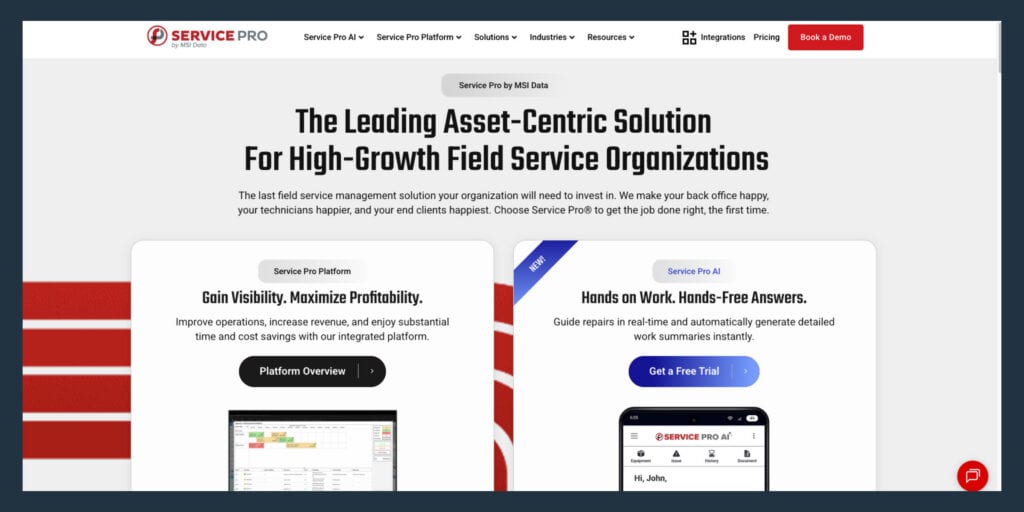
Service Pro by MSI Data
Service Pro is an asset-centric field service management platform built for equipment-heavy service organizations running 50 or more field technicians and $50M or more in annual revenue. In power generation, that means service teams managing generators, turbines, switchgear, and related assets under complex service contracts.
The platform covers asset-centric work orders, contract and warranty enforcement at work-order intake, offline mobile access, PM auto-scheduling, high-volume inspection checklists, and native ERP integrations with Sage 100, NetSuite, Epicor Prophet 21, and Microsoft Dynamics Business Central. Service Pro AI adds Job Prep Briefs and automated invoice agents, plus warranty agents that check completed work against coverage terms. Every AI trial includes a Forward Deployed Engineer embedded with the customer’s team. MSI Data has focused exclusively on field service management for more than 15 years, with an entirely US-based team.
- Best fit: Mid-market power generation service organizations with complex service contracts, ERP-connected back offices, and 50-plus technicians.
- Key differentiator: Asset-centric architecture with native ERP integrations and automated contract and warranty enforcement at work-order intake.
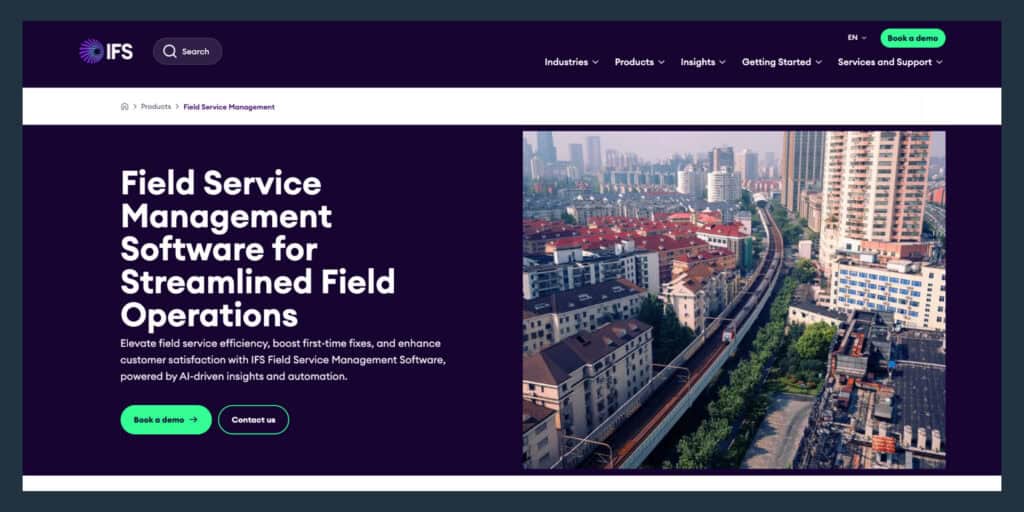
IFS Cloud
IFS is an enterprise-grade platform that combines FSM, EAM, ERP, and CRM capabilities in a single system, with meaningful capability for energy and utilities organizations including workforce planning and contract lifecycle management.
- Best fit: Large power generation or utilities organizations seeking an integrated ERP-EAM-FSM suite.
- Trade-off: Implementation complexity and cost are higher than purpose-built FSM platforms, making it a harder fit for mid-market organizations that need a focused FSM layer on top of an existing ERP.
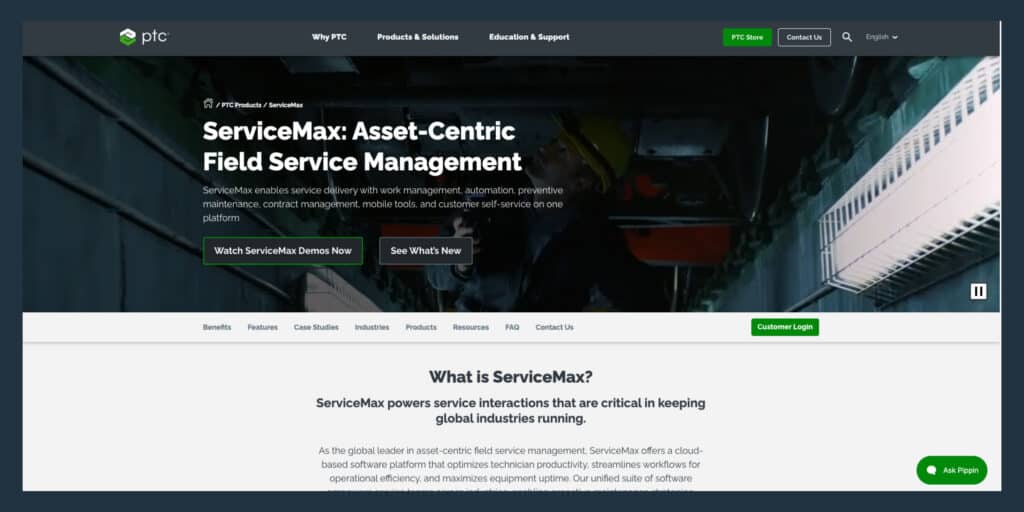
ServiceMax
ServiceMax (now part of Salesforce) is an asset-centric FSM platform built for equipment-heavy industries including energy and manufacturing. Its strengths include asset lifecycle management and predictive maintenance, with deep Salesforce CRM integration, though it runs on the Salesforce platform, so organizations without Salesforce infrastructure face additional licensing and integration overhead.
- Best fit: Organizations already running Salesforce that need asset-centric FSM with strong analytics.
- Trade-off: Pricing and platform dependency make it a significant commitment for organizations not already in the Salesforce ecosystem.
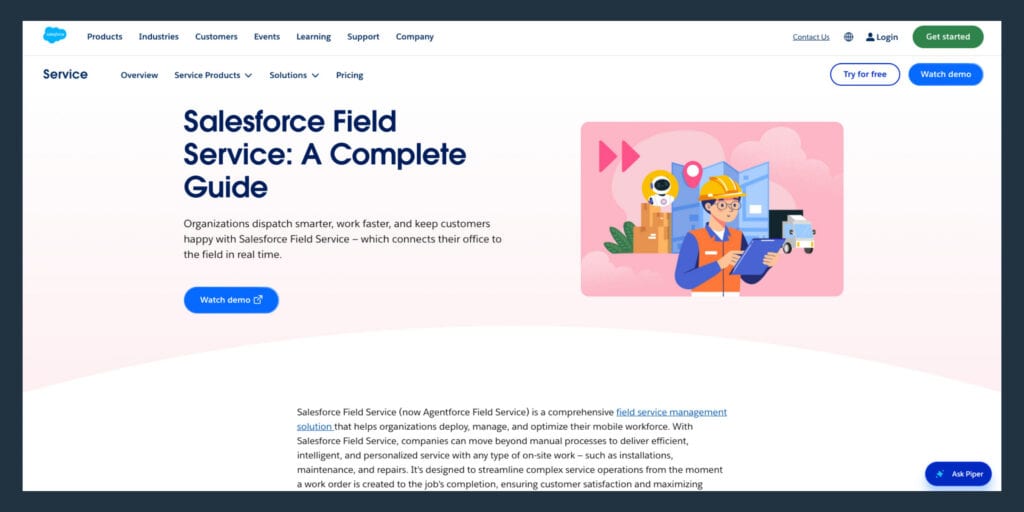
Salesforce Field Service
Salesforce Field Service has AI-assisted scheduling and IoT monitoring for connected assets, plus strong CRM integration. The IoT and connected asset capabilities are genuinely useful for remote monitoring, though the platform is designed for enterprise scale and requires significant configuration for asset-heavy service workflows.
- Best fit: Large enterprises with existing Salesforce infrastructure and connected asset monitoring needs.
- Trade-off: Salesforce publishes a dedicated limitations list for offline mobile use, including Visualforce pages not supported and lookup filters not supported, which matters for power generation sites with large installed bases and long service histories.
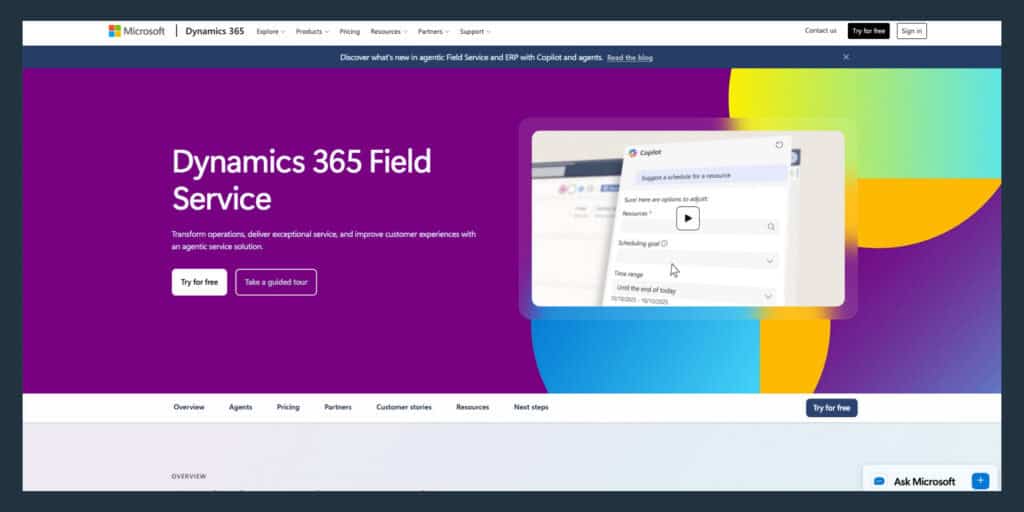
Microsoft Dynamics 365 Field Service
Microsoft Dynamics 365 Field Service integrates FSM with the broader Microsoft ecosystem (Teams, Azure IoT, Business Central, Power Platform), with reasonable scheduling and work order capabilities for organizations already running Microsoft infrastructure.
- Best fit: Organizations running Microsoft Dynamics ERP and Business Central who want FSM within the same vendor relationship.
- Trade-off: Deep asset-centric workflows require customization that purpose-built alternatives handle out of the box.
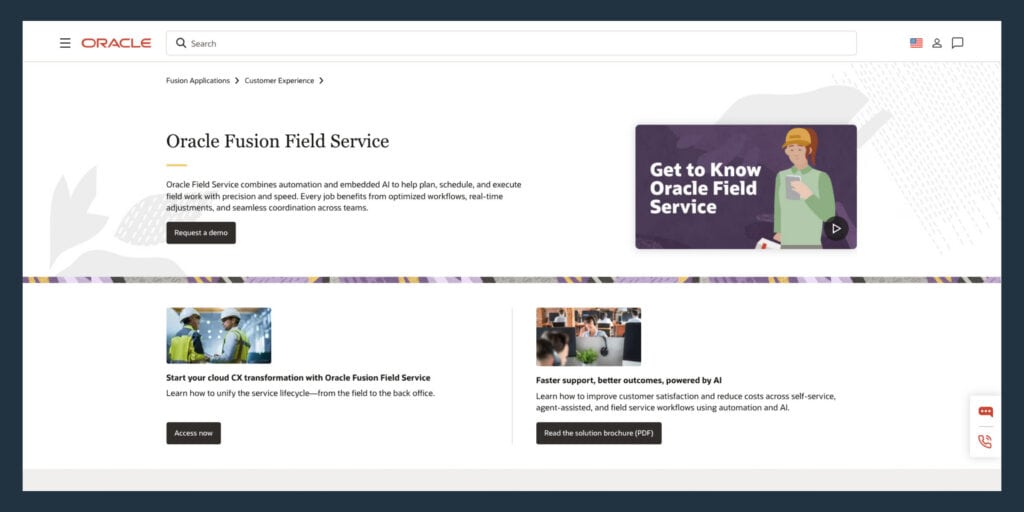
Oracle Field Service
Oracle Field Service uses AI-driven scheduling and route optimization and connects to Oracle’s broader CX and ERP ecosystem, with strong scheduling intelligence and IoT monitoring for connected equipment.
- Best fit: Large power generation organizations running Oracle ERP who need AI-optimized scheduling at high technician volume.
- Trade-off: Not practical for organizations outside the Oracle ecosystem.
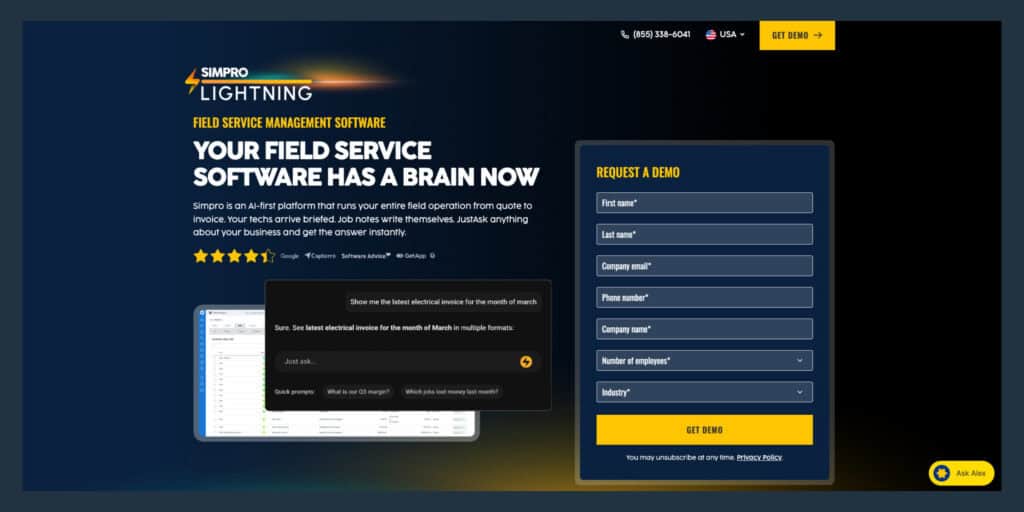
Simpro
Simpro is a cloud-based FSM platform built for trade contractors, more commonly used in HVAC and plumbing than in power generation. It has solid core FSM functionality with less depth in asset lifecycle management and contract enforcement.
- Best fit: Mid-market service organizations that need solid scheduling, job costing, and PM automation without complex asset management.
- Trade-off: ERP connectivity often surfaces through partner marketplace integrations rather than native connectors.
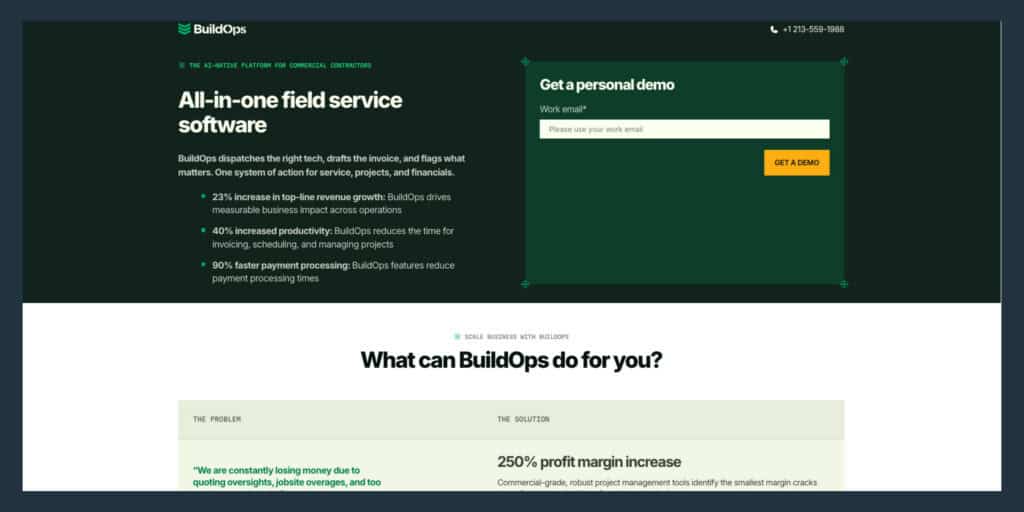
BuildOps
BuildOps is built for commercial contractors, with particular strength in HVAC and electrical work. It has strong scheduling and dispatch capabilities with solid mobile access, though it lacks the asset lifecycle and contract enforcement depth that power generation service organizations typically require.
- Best fit: Commercial contractors in HVAC and electrical who need scheduling and dispatch at scale.
- Trade-off: Not designed for the asset-centric, contract-heavy workflows of power generation service.
How do the top field service software options compare?
| Platform | Asset-centric work orders | Contract and warranty enforcement | Offline mobile | PM auto-scheduling | ERP-native integration | Power generation focus |
| Service Pro by MSI Data | Yes | Yes | Yes | Yes | Yes (Sage, NetSuite, Epicor, BC) | Yes |
| IFS Cloud | Yes | Yes | Yes | Yes | Yes (own ERP) | Partial |
| ServiceMax | Yes | Partial | Yes | Yes | Partial (Salesforce) | Partial |
| Salesforce Field Service | Partial | Partial | Partial | Partial | Partial | No |
| Microsoft Dynamics 365 FS | Partial | Partial | Yes | Partial | Yes (Microsoft stack) | No |
| Oracle Field Service | Partial | Partial | Yes | Partial | Yes (Oracle stack) | No |
| Simpro | Partial | No | Yes | Yes | Partial | No |
| BuildOps | No | No | Yes | Partial | Partial | No |
What metrics prove the software works?
The right FSM software moves specific numbers. These are the metrics power generation service leaders use to measure whether the platform is delivering value, and each one connects directly to a profitability outcome that shows up in contract renewals.
First-time fix rate
First-time fix rate is the percentage of service calls resolved on the first visit. A second truck roll doubles labor cost, delays the invoice, and damages the customer relationship. Industry best-in-class is approximately 88%; most mid-market operations run closer to 70% for industrial machinery, according to Aquant’s 2024 Field Service Benchmark Report.
FSM software moves this number through asset history at the equipment level and skill-based dispatch, combined with parts confirmation before departure.
Technician utilization
Technician utilization is the share of a technician’s available hours spent on billable work. In power generation service, underutilization comes from poor scheduling (wrong tech dispatched, requiring a reassignment) or excessive windshield time from poor routing. Skill-based dispatch and route optimization compress non-billable time and increase the percentage of hours that generate revenue.
PM on-time completion
PM on-time completion is the percentage of scheduled preventive maintenance visits completed within the required service window. Auto-triggered PM scheduling flags overdue PMs before they become compliance or warranty issues, rather than after a failure has already occurred.
Time to invoice
Paper-based field service operations routinely create two-to-six-week invoice lag, according to documented case studies including MSI Data’s own case study, where billing often took two weeks or more. Best-practice organizations compress this to days once technicians close jobs digitally in the field. Service Pro’s automated invoice agent generates an invoice record from the completed work order and syncs it to the ERP the same day the job closes.
Warranty revenue recovery
Warranty revenue recovery is the dollar value of warranty-covered work that is correctly identified and claimed rather than written off as unbillable. Contract and warranty enforcement at work-order intake flags coverage terms before a technician is dispatched, so the service manager makes a billing decision before the truck rolls. WPI recovered $2.9 million in warranty claim recoveries in less than one year after implementing Service Pro’s coverage enforcement.
How should you choose field service software?
Evaluating FSM software for power generation is not the same as evaluating general field service tools. Buyers who skip the workflow mapping step end up evaluating features they do not need and missing the ones they do.
Map service workflows before demos
Before evaluating any platform, document how work orders are created, how technicians are dispatched, how parts are sourced, and how invoices are generated today. A dispatcher who currently works from spreadsheets needs to see the scheduling board in action, not a slide about AI optimization.
Test offline mobile work in the field
Ask to run the mobile app in airplane mode during a demo and complete a work order end-to-end. Power generation sites often have no signal, and a mobile app that requires connectivity fails at the job site.
Validate ERP data ownership
Ask each vendor directly: where is the FSM system master of data, and where is the ERP master? Work order data and parts consumption should flow from FSM to ERP, along with labor time, not the other way around, and not through a manual export. Ask the vendor to demonstrate the integration live, not describe it on a slide.
Service Pro connects natively to Sage 100, NetSuite, Epicor Prophet 21, and Microsoft Dynamics Business Central, with work order data and parts consumption flowing directly into the ERP’s billing and inventory records without double entry, along with labor time.
Set adoption targets before rollout
The biggest FSM implementation failures come from deploying software without defining what success looks like for technicians in the first 90 days. Set specific adoption targets before signing: what percentage of work orders will be created in the system, what percentage of invoices will sync same-day, what percentage of PMs will be auto-generated, and what percentage of technicians will use the mobile app daily.
Service Pro includes a Forward Deployed Engineer embedded with the customer’s team during AI adoption, because software adoption is an organizational effort that needs real support, not just a login.
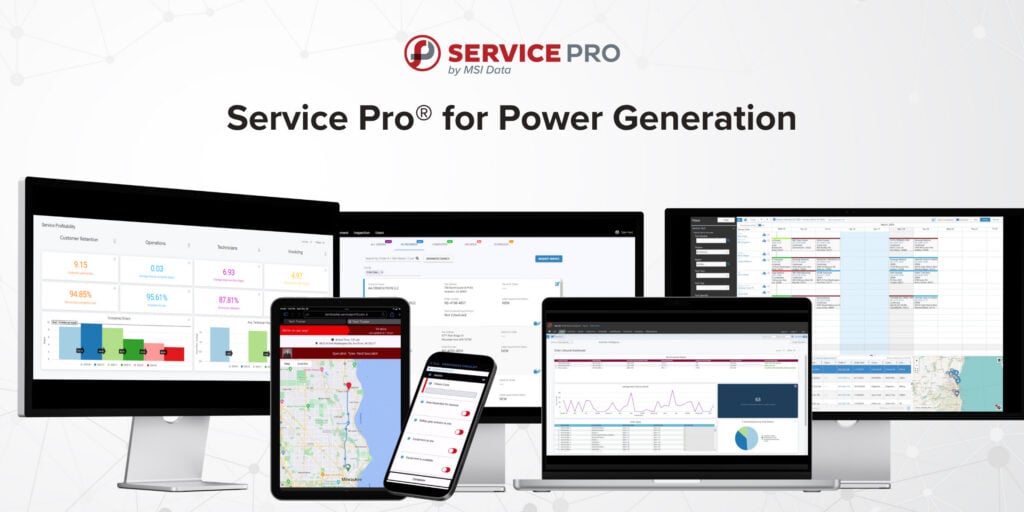
How does Service Pro work with power generation companies?
Service Pro by MSI Data is an asset-centric field service management platform built for power generation service teams managing generators, turbines, switchgear, and related assets under complex service contracts, typically running 50 or more field technicians and $50M or more in annual revenue.
- Asset-centric work orders carry the full equipment history into every job.
- Contract and warranty enforcement at work-order intake checks coverage terms before a technician is dispatched.
- Offline mobile access works at remote and low-signal sites.
- PM auto-scheduling generates work orders from run-hour and calendar triggers.
- High-volume inspection checklists attach at the work-order level so every tech follows the same procedure on the same equipment type.
Service Pro AI adds Job Prep Briefs (a pre-job summary generated from the asset’s history, prior work orders, and equipment documentation) and automated invoice agents (generates an invoice record from the completed work order and syncs it to the ERP the same day the job closes). Warranty agents check completed work against coverage terms and flag any items that should be billed differently before the invoice goes out. Every AI trial includes a Forward Deployed Engineer embedded with you from day one.
MSI Data has focused exclusively on field service management for more than 15 years, with an entirely US-based team.
Ready to see how Service Pro handles power generation service? Schedule a free demo.
Frequently Asked Questions
What is the best field service management software for power generation companies?
Service Pro by MSI Data is purpose-built for asset-centric, contract-driven service organizations in power generation, with native ERP integrations and automated contract and warranty enforcement, plus offline mobile access for remote sites. IFS Cloud and ServiceMax are strong alternatives for large enterprises with the budget and IT resources for a full platform implementation.
How is FSM software different from a CMMS or EAM?
A CMMS (Computerized Maintenance Management System) and EAM (Enterprise Asset Management) system focus on tracking asset condition and maintenance history, while FSM software manages the field service operation: scheduling technicians, dispatching work orders, enforcing contracts, and syncing invoices to the ERP.
Does power generation FSM software require offline access?
Power generation assets are frequently located at remote sites, substations, and industrial campuses where cell signal is unreliable, so offline-capable mobile access is a baseline requirement for this vertical, not an optional feature.
Can FSM software connect to an existing ERP without replacing it?
Purpose-built FSM platforms like Service Pro connect to ERPs like Sage 100, NetSuite, Epicor, and Microsoft Dynamics Business Central through native integrations, so work order data and parts consumption flow into the ERP without manual re-entry or a system replacement, along with labor time.
How does AI fit into power generation field service management?
AI in FSM is most useful when it draws from the organization’s own asset records and service history, generating pre-job briefs for technicians and checking completed work against contract terms. It also produces same-day invoice records. Generic AI tools cannot substitute because they lack access to the organization’s equipment data.